Search Engine Optimization (SEO) was the name of the web search game until perhaps the last few years; now, however, AI chatbot summaries have taken over. More and more people rely on these quick and handy summaries, which provide—or at least are expected to provide—a refined overview of the topic in question. But is that actually the case, and if not, what could the consequences be? That is the question this article addresses, though it wasn’t where I originally started.
The topic of this article was supposed to be science and its headlines, with an emphasis on microplastics. However, research training has taught me that once you start exploring, results often steer you in new directions. That is the beauty of the scientific method: the hypothesis is only the first step. You then begin asking questions and working your way through the labyrinth of results to reach a conclusion.
My hypothesis: Shock-value science journalism misleads the public by oversimplifying complex observational studies.
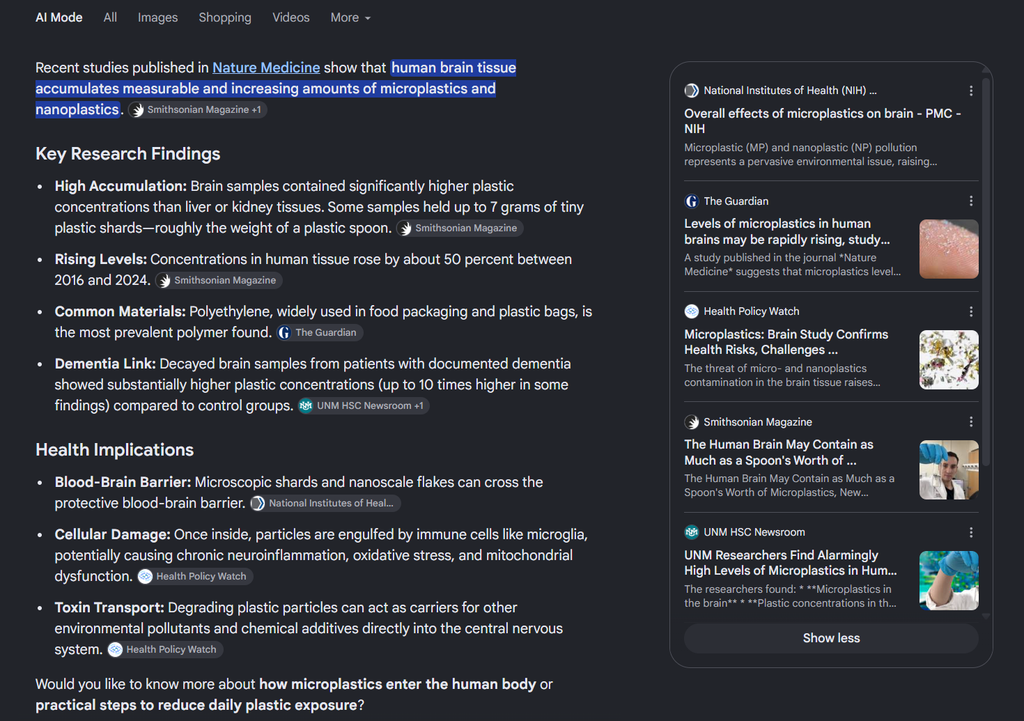
My question—or rather, my Google search—was simply “microplastics and brain.” Google’s AI mode came back with the following statement: “Recent studies published in Nature Medicine show that human brain tissue accumulates measurable and increasing amounts of microplastics and nanoplastics.” The search cited five different sources it had used to develop this summary. Interestingly, the actual Nature Medicine article by the University of New Mexico (UNM) research group, although open access, was missing from the source list. Instead, its primary citations—as shown in a screenshot below—were materials published in news articles: The Guardian, Health Policy Watch, Smithsonian Magazine, the University of New Mexico press release, and a research article published in Frontiers in Toxicology (available on PubMed Central).
Screenshot of the AI mode result to my Google search using keywords microplastics and brain.
I had set out to investigate these headlines, knowing that the primary UNM study had received what is fairly common in new avenues of research: a scientific challenge. The Nature Medicine article used Py-GC/MS detection of polymer solids, and other experts, in a correspondence piece, put forth arguments concerning the limitations of Py-GC/MS for microplastics detection in tissues. This was precisely my follow-up question to the AI bot. Conveniently enough, the bot came back with a nuanced summary: “The use of Pyrolysis-Gas Chromatography-Mass Spectrometry (Py-GC/MS) to detect microplastics in human organs has triggered intense debate within the analytical chemistry and toxicology communities. While Py-GC/MS is uniquely valuable because it measures total polymer mass rather than individual particle counts—allowing it to capture ‘invisible’ sub-micron nanoplastics—its application to complex biological tissues carries significant technical arguments.”
Screenshot of my follow-up question and the summarized answer provided by the chatbot.
Funnily enough, while I was researching how news media articles latch onto “shock-value” research results, The Guardian was once again the top source for the AI bot. Credit goes to The Guardian for publishing a detailed story on the challenges faced by the original research article, and credit to the scientific publishing enterprise for strengthening scientific dialogue and the scientific method.
My initial hypothesis was partially correct: news media headlines on scientific discoveries can sometimes be misleading, likely because that is the nature of their relationship. Science is always exploring and evolving. A new discovery makes for a good headline, but good journalism follows up when that discovery is challenged and makes sure the response gets attention too.
However, my hypothesis and my question led me to an unexpected result that wasn’t even on my radar: AI chatbots. Increasingly integrated into daily life, AI is marketed as an amazingly intelligent companion to help with all our needs. Yet, much like humans, it has blind spots and limitations. I am a strong proponent of the value LLMs can bring to our lives, but we must recognize that they are simply tools providing curated access to vast reserves of human knowledge. Just like any tool, we need to learn its proper usage, applications, and limitations.
Traditional search engines used to hand you a scattered list of links, forcing you to do the heavy lifting of clicking through, cross-referencing, and evaluating what was credible. But an LLM doesn’t just search; it weaves. It takes a handful of disparate sources, blends them together, and presents them back to you in a single, polished, authoritative-sounding narrative. Because the output reads so cohesive and complete, it lulls you into a false sense of security. You are far less likely to question or cross-check an answer that feels like it has already done all the thinking for you—even when, as in my case, it completely bypassed the primary academic paper in favor of secondary news reports.
I am glad my training in critical thinking helped me look past this blind spot, and I hope this reflection can help others do the same.
Let me begin by saying that I liked the movie, Dhurandhar, the first part more than the second. But overall, both are entertaining movies, with good stories and compelling characters.
I suppose much more can be said about the movie, but this is not a movie review; it is a critical commentary. So, this should suffice.
My somewhat simplistic take on the movie’s success is that it taps into something Indian cinema has rarely explored at this scale: the fantasy of an Indian intelligence operative possessing the same mythic competence that audiences have long accepted in characters such as James Bond, Ethan Hunt, and Jason Bourne—or, for Vin Diesel fans, Xander Cage or Dominic Toretto.
That is, of course, a simplistic take. I am sure there is a whole host of other factors at play. But that is not the subject of this commentary either.
This is a Critical Thought commentary, presenting a problem and a perspective, hopefully, to leave the reader with something to think about.
Let’s begin with the perspective: In most stories inspired by real events, especially those involving intelligence operations, wars, scientific achievements, or national crises, it is almost impossible to faithfully represent the contributions of dozens, hundreds, or sometimes thousands of people. The result is that filmmakers create a single character who becomes a vessel for many real individuals.
The series’s main protagonists are Prof. Valery Legasov and Boris Shcherbina. The key Soviet officials who led the government commission managing the aftermath of the 1986 Chernobyl nuclear disaster. Legasov was the chief scientist providing technical expertise, while Shcherbina was the Deputy Prime Minister directing the massive logistical and operational cleanup. Another character who stands alongside them throughout the story is Prof. Ulana Khomyuk.
Before moving ahead, on a side note, if you haven’t watched the series, it is one of my strongest recommendations—storytelling of the highest order and a remarkably compelling account of one of the greatest disasters in human history and the people who worked to contain it.
Now back. The creators of the series were remarkably transparent in acknowledging that Ulana Khomyuk was not a real person but a composite character representing numerous scientists who worked to understand the disaster, uncover the truth, and protect the public. Rather than claiming a single hero solved everything, the series openly admitted the limitations of storytelling.
Viewed through that lens, the protagonist of the Dhurandhar movies, Jaskirat Singh, becomes much more compelling.
He ceases to be a superhero.
Instead, he becomes a symbol.
A symbol of countless intelligence officers, soldiers, informants, diplomats, analysts, police personnel, and ordinary citizens who, over decades, contributed in ways that will never make it into public records. Some may have prevented attacks. Some may have gathered critical intelligence. Some may have infiltrated hostile networks. Some may have simply stood watch at a border post on a cold night. All of them, just like Jaskirat, have a personal story, beyond their national duties.
The audience sees one face because cinema needs one face.
Reality rarely works that way.
The success of any intelligence operation is almost always cumulative. It is built upon years of information gathering, hundreds of decisions, countless unnamed contributors, and often the sacrifices of people whose stories remain classified or untold. The public remembers the visible outcome; history is usually carried by invisible individuals. The movie does acknowledge a few such individuals through the typical storytelling trope of character reveals.
In that sense, perhaps the most meaningful interpretation of Jaskirat Singh is not as a single spy who accomplished extraordinary things, but as a narrative embodiment of a collective effort.
A character through whom the audience can appreciate a community of service that, by its very nature, cannot publicly tell its own story.
And perhaps that is why the character resonates.
Not because viewers truly believe one man did everything shown on screen.
But because they intuitively understand that behind every nation enjoying a normal day are countless people, known and unknown, whose work made that normalcy possible.
The difference between cinema and history is that cinema compresses many lives into one character. History expands one character back into the many lives that made the story possible.
Now, beyond this perspective, there is a second fold of this commentary, i.e., the problem.
History provides enough examples of governments getting things wrong. Democracies routinely debate policy failures, intelligence failures, and political misjudgments. The problem is not that the film depicts corruption, incompetence, or political compromise.
The leap occurs when a narrative moves from:
“Governments made mistakes”
to
“Successive governments knowingly collaborated with forces actively harming their own citizens.”
Those are fundamentally different claims.
The first is plausible, common, and historically observable.
The second is an extraordinary claim and thus requires extraordinary evidence. It implies not isolated failures but a sustained conspiracy across multiple administrations, institutions, and individuals over decades.
That is where Dhurandhar’s emotional logic and political logic begin to diverge.
Interestingly, the movie itself appears to contain a contradiction. It presents ordinary Pakistani citizens as capable of empathy, humanity, and moral courage. In other words, individual human beings are shown with nuance and complexity.
Yet the same narrative asks viewers to accept that generations of elected leaders on the Indian side acted with near-uniform cynicism and deliberate malice toward their own people.
From a storytelling perspective, one group is treated as human; the other becomes a caricature.
And that is often a sign that a narrative is operating more in the realm of mythology than political analysis.
This is not unique to Indian cinema. Many countries produce stories where national problems can be traced to a handful of villains, traitors, or conspirators. Such explanations are dramatically satisfying because they simplify reality.
The real world is usually less cinematic.
Terrorism persists not because everyone secretly supports it, but because it emerges from a tangled web of geopolitics, ideology, historical grievances, intelligence failures, bureaucratic inertia, strategic calculations, and human error. That explanation is messier, less emotionally satisfying, and far harder to fit into a three-hour screenplay.
I don’t have a problem with the heroism of Dhurandhar’s protagonist, but the casualness with which an extremely serious accusation is woven into entertainment.
If a filmmaker wants audiences to believe that multiple governments knowingly aided terrorist networks, that is no longer merely a dramatic device. It is a claim with profound implications. If such a thing were demonstrably true, it would warrant investigations, accountability, public disclosure, and historical reckoning. Not simply a dramatic reveal followed by applause.
The challenge for politically charged cinema like Dhurandhar is that audiences often leave the theater carrying away not the action sequences, but the underlying assumptions about how the world works.
And perhaps that is the most interesting discussion raised by Dhurandhar:
At what point does a fictional narrative stop being a patriotic fantasy and start becoming a political assertion?
That boundary is often much blurrier than filmmakers—and audiences—realize.
Closing
Movies are a medium for vicarious living, and the success of this movie, to me, is also a reflection of India’s growing self-confidence. Perhaps that is part of what it means to be a young country. After all, roughly 65% of our population is below the age of 35.
But youth can also be impressionable, and that is where we ought to exercise some caution with movies such as this—particularly when the line between fiction and reality is deliberately blurred. Fiction mixed with reality is a difficult balance to strike, and creators working on such a scale should recognize the responsibility that comes with shaping how a society thinks about its own history and reality. There is a difference between taking creative liberties with a character and asking an audience to accept an extraordinary version of reality.
As for the audience, we should be able to fully enjoy the fantasy of the Indian spy without mistaking the fantasy for history. We can celebrate the people Jaskirat represents without necessarily accepting every explanation the screenplay offers for how the world works.
Patriotism does not require us to suspend critical thinking. If anything, a country worth protecting is a country worth thinking critically about.
If I have seen further, it is by standing on the shoulders of giants.
A famous and timeless quote. The same has been traced back to the 12th-century French philosopher Bernard of Chartres, who said that we are like dwarfs on the shoulders of giants, so that we can see more than they can, and things at a greater distance, not by virtue of any sharpness of sight on our part or any physical distinction, but because we are carried high and raised up by their giant size.
However, Sir Isaac Newton famously popularized this in a 1675 letter to his rival Robert Hooke. Historians often note that this was a subtle (and perhaps sarcastic) nod to Hooke’s physical size and their bitter rivalry, but it became the ultimate symbol of scientific collaboration.
This timeless quote means that our greatest modern achievements, innovations, and discoveries are not made in isolation; they are only possible because we build upon the foundational work of our predecessors.
These foundational works are the result of the tireless efforts of multitudes of individuals, generation after generation. These efforts can take myriad forms and shapes: countless lab hours, late nights, skipped meals, time away from family and friends, and sometimes putting one’s own life and health on the line, all for the love of science.
Max von Pettenkofer and Dr. Barry Marshall lived almost a hundred years apart from each other; however, both seemed to have a taste for bacterial cultures.
Pettenkofer, attempting to disprove Robert Koch’s theory that the Vibrio cholerae bacterium alone caused cholera, drank a broth teeming with live cholera bacteria in 1892. Later, in 1984, faced with a skeptical medical establishment, Marshall deliberately swallowed a culture of Helicobacter pylori bacteria.
Pettenkofer suffered mild symptoms, while Marshall developed severe gastritis and ulcer symptoms within days. Marshall successfully proved the bacterial link, revolutionizing gastrointestinal treatment, and won the 2005 Nobel Prize in Physiology or Medicine. On the other hand, while Pettenkofer believed he had won the argument, he had simply gotten lucky. He did not become severely ill because of specific biological factors, not because Koch’s germ theory was wrong.
Pettenkofer and Marshall, same experiment, mostly the same reason—an absolute readiness to do anything for the love of science. Their results differed, but these were giants who had the “stomach” for risks and, obviously, a good culture of bacteria.
A similar giant was Werner Forssmann. In 1929, this German surgical resident believed doctors could thread a tube directly into a living human heart. Disobeying his superiors, he anesthetized his own arm, inserted a 65-centimetre urological catheter into a vein, and pushed it all the way into his heart’s right atrium. He then walked down to the X-ray department to prove it.
He was fired for his recklessness but eventually won the 1956 Nobel Prize when the technique revolutionized cardiology.
Continuing the traditions of these mavericks, enter “medicine’s most-measured man,” Dr. Michael Snyder, a geneticist at Stanford University.
For well over a decade, Dr. Snyder has routinely tracked his body’s molecular shifts. He frequently draws his own blood, tracks his gut microbiome, and monitors his urine and stool. He measures thousands of distinct variables simultaneously, including his genome, proteins, and metabolic markers. He uses his own body as a continuous, high-tech laboratory to pioneer personalized medicine and multi-omics profiling.
Rather than swallowing acute toxins, Dr. Snyder subjects his body to endless, invasive, and intensive personal data monitoring.
Beyond these medicine pioneers, there are notable others who have taken the road less travelled, or simply the road of physical pain.
“Almost pleasant, a lover just bit your earlobe a little too hard.”
Don’t worry, the blog is not taking a wrong turn. This is how Justin Schmidt described the sting of an anthophorid bee.
Schmidt, an entomologist from Arizona, developed the Schmidt Sting Pain Index by subjecting himself to stings from at least 96 species of insects, including bees, hornets, wasps, and ants. Entomologists, pest control professionals, and researchers use it to quantify venom defenses, understand insect behavior, and evaluate potential medical or safety risks to humans.
Before we move on to our next warrior, here’s another of Schmidt’s poetic descriptions, this time after being stung by a warrior wasp:
“Torture. You are chained in the flow of an active volcano. Why did I start this list?”
Moving from stings to broken bones, introducing the Fastest Man on Earth, John Paul Stapp.
This U.S. Air Force officer and surgeon wanted to know how much deceleration forces a human pilot could survive during a crash. Strapped into a rocket-powered sled nicknamed “Gee Whiz”, he propelled himself at 632 miles per hour (1,017 km/h) and stopped in just 1.4 seconds.
The brutal stops fractured his ribs, broke his wrists, and caused his eyes to bleed, but his data directly led to the invention of modern commercial car seatbelts and military ejection seats. Stapp was at Lyndon Johnson’s side in 1966 when the then-US president signed a law requiring carmakers to install seat belts.
While we talk of giants and pioneers, how can we forget Sir Isaac Newton? And no, I am not talking about the apple falling on his head, which, as it happens, has little truth to it and is simply one of those stories that survives because it is too good not to.
All Newton himself ever said, as noted by Stephen Hawking in A Brief History of Time, was that the idea of gravity came to him as he sat “in a contemplative mood” and “was occasioned by the fall of an apple.”
Coming back, Newton subjected himself to a variety of experiments in the name of curiosity. Intrigued by how the human eye perceives light and colour, he slid a blunt bodkin (a large needle) into his own eye socket, pressing against the back of his eyeball until he saw coloured circles and flashes. He also stared directly at the sun with one eye for as long as he could bear, nearly blinding himself for days in order to study after-images.
You might have noticed some of the words I have used to describe these scientists and researchers so far—words not always associated with this breed of individuals: warriors, mavericks.
Another word that is seldom used, but unfortunately comes with the practice of peering into the unknown, is martyrs.
In the 19th century, isolating the highly reactive and incredibly toxic element fluorine was one of the most perilous quests in chemistry.
The Louyet Brothers & Jerome Nickels: Belgian chemist Paulin Louyet and French chemist Jerome Nickels both died from inhaling toxic hydrofluoric acid vapors while attempting to isolate the element.
George and Thomas Knox: These Irish brothers suffered severe poisoning and permanent health damage while working on the same problem. They survived, but the collective deaths and injuries earned this era of chemists the grim title of the “Fluorine Martyrs”.
Similarly, early pioneers of radiation had no idea that the strange, glowing energy they were studying was actively destroying their cellular DNA.
Marie Curie: The legendary two-time Nobel laureate discovered radium and polonium. She routinely carried glowing test tubes in her coat pockets and stored them in her desk drawers. She died in 1934 from aplastic anemiacaused by decades of radiation exposure. Her research notebooks remain so radioactive today that they must be kept in lead-lined boxes.
Clarence Dally: An assistant and glassblower to Thomas Edison, Dally enthusiastically tested early X-ray tubes on his own hands. He developed aggressive skin cancers, leading to the amputation of both arms before he died in 1904.
All of the above, and many others like them, are heroes who put their lives on the line because, for them, there really is
nothing that they will not do for science!
And perhaps this is what Newton’s famous quote truly means. When we speak of standing on the shoulders of giants, we often think of great ideas, groundbreaking theories, and transformative discoveries. But behind those achievements stand real people—individuals who swallowed bacteria, threaded catheters into their own hearts, endured venomous stings, exposed themselves to radiation, and sometimes paid the ultimate price in pursuit of knowledge.
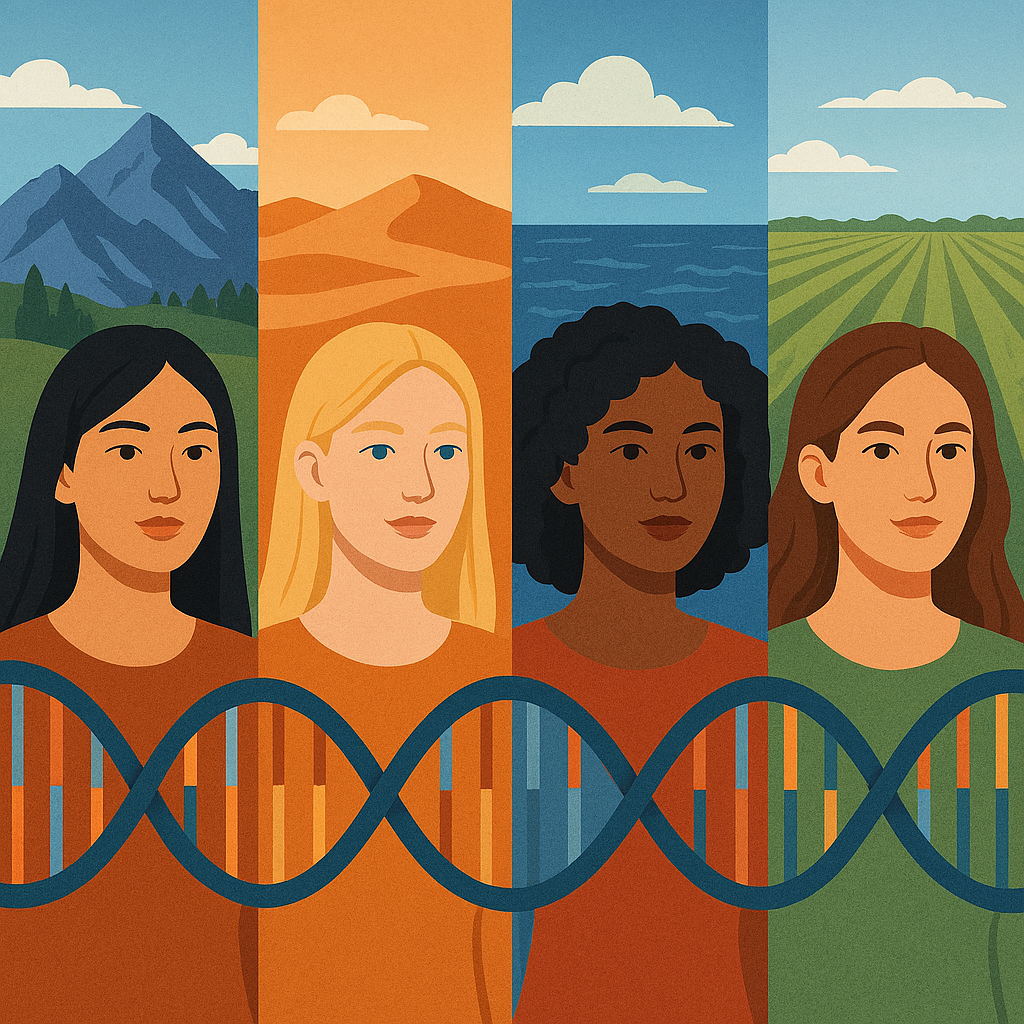
It is frequently stated that any two peoples’ genomes are ~99.9% identical to one another. In reality, any two peoples’ genomes are, on average, ~99.6% identical and ~0.4% different [Ref: National Human Genome Research Institute]. Even with the slightly increased difference from the popular notion, it is fair to say that genetically, we are identical. One of our nearest primate cousins, the chimpanzees, are subdivided into races, but humans are not [Ref: Templeton AR. Biological races in humans. Stud Hist Philos Biol Biomed Sci. 2013 Sep;44(3):262-71].
Adaptive traits, such as skin color, have frequently been used to define races in humans, but such adaptive traits reflect the underlying environmental factor to which they are adaptive and not overall genetic differentiation.
This raises an intriguing question.
If human beings are genetically so similar, why do human populations living across different regions have developed recognizable differences in physique, health patterns, behavioral tendencies, and social characteristics?
The answer may lie in one of the most fascinating ideas in modern biology:
Genes alone do not determine human outcomes.
People often imagine genes as rigid instructions. We all have come across phrases like having “good genes” or “bad genes,” but Genes Are Not Static Instructions.
Genes are dynamic, context-dependent resources rather than static, unchangeable instructions. Modern genomics shows that DNA functions as an open, reactive system. A single genetic sequence can produce vastly different outcomes depending on structural, chemical, and environmental context.
And this is where epigenetics enters the story.
Epigenetics is the study of heritable but reversible modifications in gene expression.
Importantly, epigenetics usually does not alter the DNA sequence itself. Instead, it modifies how genes are used.
A useful analogy is to think of DNA as the script of a play. Epigenetics influences which scenes are emphasized, which lines are muted, and how the performance unfolds under different conditions.
The same genome can therefore produce remarkably different outcomes depending on the environment surrounding it.
Human beings are not shaped in isolation. We are deeply ecological organisms. The landscapes we inhabit quietly influence diet, climate exposure, pathogen environments, labor intensity, stress levels, pollution exposure, social organization, and lifestyle patterns.
Over generations, these shared environmental conditions begin producing shared biological tendencies across populations living within the same geography.
This does not happen absolutely or deterministically. But geography exerts a continuous pressure that shapes developmental patterns over time.
Shared Geography Creates Shared Humans
Travel across northern India, and a fascinating pattern quietly emerges. Whether in Haryana, western Uttar Pradesh, or large parts of Rajasthan, people across different communities often appear remarkably similar in broad physical build, food habits, social temperament, and even behavioral rhythms. The similarities frequently transcend the social identities people use to define themselves. This agrarian belt of India across communities, generations have historically shared physically demanding agricultural labor, dairy-rich diets, hot climatic conditions, similar pathogen environments, common water systems, and comparable social structures.
These shared conditions influence human development in subtle but cumulative ways. Nutrition affects height and musculature. Labor shapes metabolism and physical adaptation. Climate influences behavioral rhythms and daily routines. Chronic environmental stressors shape hormonal systems and immune responses.
Over time, landscapes begin leaving signatures upon the humans who inhabit them.
The same broad principle appears globally.
Across the Mediterranean basin and the Middle East, populations separated by modern national borders often display overlapping facial structures, dietary cultures, and social behaviors shaped by centuries of living within similar climates and trade networks. In the United States, regional differences between the Deep South, the Northeast, the Midwest, and the Mountain West are not merely cultural stereotypes; they often reflect long histories of climate, labor patterns, food systems, urbanization, migration, and environmental pressures shaping populations over generations.
The Body Remembers Environment
One of the most remarkable discoveries in biology is that the body does not merely react to environments in the present. In some cases, environmental experiences can leave biological marks that persist across time.
In the winter of 1944–45, a German blockade created a devastating famine in the Nazi-occupied Netherlands. Pregnant women exposed to severe starvation gave birth to children who later displayed increased risks of obesity, diabetes, cardiovascular disease, and metabolic disorders.
Decades later, researchers discovered altered epigenetic patterns associated with genes involved in growth and metabolism among individuals exposed to famine in the womb.
The DNA sequence itself had not changed.
What changed was how the body regulated the use of certain genes in response to extreme environmental stress.
This became one of the most influential demonstrations of how environments may biologically influence populations across time.
And famine is only one example.
Epigenetic influences are now being studied in relation to chronic stress, malnutrition, toxin exposure, pollution, trauma, socioeconomic hardship, sleep deprivation, and long-term inflammatory conditions.
What is striking is that many of these are not purely individual experiences.
They are often shared geographical realities.
The environment, therefore, becomes not just a backdrop to human life, but an active biological participant in shaping it.
Communities living within the same environments frequently encounter similar climates, nutritional systems, pollutants, labor demands, and stress structures.
Human Diversity Is Ecological
One of the most important insights emerging from modern biology is that human diversity cannot be understood purely through genetics alone.
Humans are adaptive organisms existing in constant dialogue with their surroundings.
The body continuously interprets environmental signals and adjusts accordingly; metabolism adapts to food availability, the immune system adapts to pathogen exposure, stress systems adapt to social pressures, and developmental pathways respond to nutrition and lifestyle.
This interaction between genes and environment helps explain why populations living in similar ecological conditions often display recognizable overlaps despite social divisions, linguistic differences, or historical identities.
It also explains why migration itself can reshape populations across generations. When environments change, lifestyles change. Diets change. Stress structures change. Exposure patterns change. And biology responds.
The human organism is not a fixed machine built solely from DNA.
It is a responsive system constantly negotiating with the world around it.
Landscapes Shape More Than Land
Perhaps one of the deepest misconceptions about human biology is the idea that genes alone define who we become.
Genes matter profoundly. But genes operate within environments, and environments are never passive.
Geography influences food systems. Food systems influence metabolism. Climate shapes labor patterns. Social structures influence stress. Pathogen environments shape immunity. Economic conditions influence development. Over generations, these forces interact continuously with human biology.
Landscapes do not merely shape civilizations.
They quietly shape the humans living within them.
Not absolutely. Not deterministically.
But continuously and powerfully across generations.
And perhaps that is one of the most fascinating truths about being human:
Identical genes do not create identical humans because human beings are not built by DNA alone.
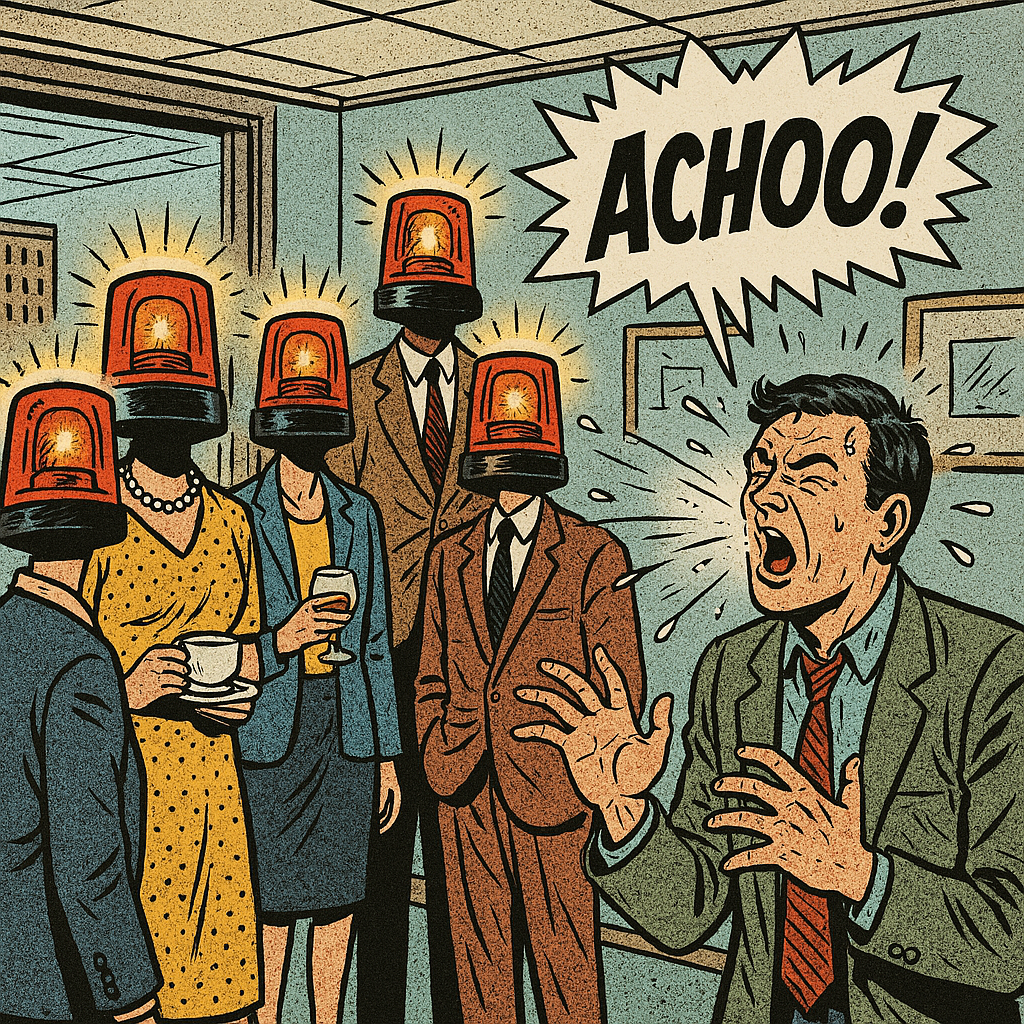
A person sneezes beside us, and we subtly lean away. Someone visibly ill enters a room, and the atmosphere changes before a single word is spoken. Even without medical knowledge, our bodies seem to react to the possibility of infection.
Similarly, during the COVID-19 pandemic, something unusual happened to human behavior. Long before many governments imposed restrictions, people had already begun stepping away from coughing strangers, avoiding crowded elevators, and instinctively creating distance between themselves and others. Some of this was conscious reasoning. But much of it felt automatic — almost ancient.
Why?
For years, scientists have understood the immune system as something that reacts after pathogens enter the body. Germs invade, immune cells mobilize, and the battle begins. But what if survival starts even earlier than that? What if the brain itself acts as an early warning system, preparing the body for infection before physical contact even occurs?
A study published in Nature Neuroscience by Sara Trabanelli and colleagues at the University of Lausanne suggests exactly that. Their research proposes something extraordinary: the human brain may begin activating components of the immune system simply by anticipating contact with disease.
Evolution Built More Than an Immune System
From an evolutionary perspective, waiting for infection is a risky strategy.
Pathogens reproduce quickly. A delayed response can mean death. Across millions of years, social species therefore evolved behaviors designed not merely to fight disease, but to avoid it altogether. Scientists sometimes refer to this collection of instincts as the behavioral immune system.
This system includes:
avoidance of visibly sick individuals,
disgust reactions,
caution around contaminated food, and
even social distancing behaviors
In many ways, prevention is biologically cheaper than repair. The age-old saying, prevention is better than cure, probably has deeper evolutionary origins.
A fascinating aspect of evolution is that it often prioritizes false alarms over missed threats. Mistakenly avoiding a healthy person costs little. Failing to avoid an infectious individual may cost survival itself. As a result, the human brain evolved to become exquisitely sensitive to signs that resemble disease, even before infection is confirmed.
But this raises a deeper question.
Could the brain merely be influencing behavior? Or could it actually be communicating with the immune system itself?
The Brain’s Invisible Protective Bubble
To understand the study, we first need to understand one of the strangest features of the human brain: the invisible safety boundary surrounding the body.
Neuroscientists call this the peripersonal space (PPS) system.
The PPS is essentially the brain’s constantly updated map of the immediate space around us — the zone where outside objects may soon touch the body. Specialized fronto-parietal brain networks continuously integrate:
visual information,
sounds,
touch,
and movement
to predict potential contact with nearby objects.
This system quietly governs countless everyday experiences.
When a ball flies toward your face, you flinch before impact. When someone stands too close behind you, discomfort emerges almost instantly. When a fast-moving object approaches, your body prepares for action before conscious thought catches up.
The brain is not passively observing reality.
It is constantly predicting what may happen next.
And according to Trabanelli et al., infection may be treated as another form of approaching threat.
Can the Brain Detect Infection Before Contact?
The researchers asked a remarkable question:
Could the human brain detect the possibility of infection early enough to trigger an anticipatory immune response?
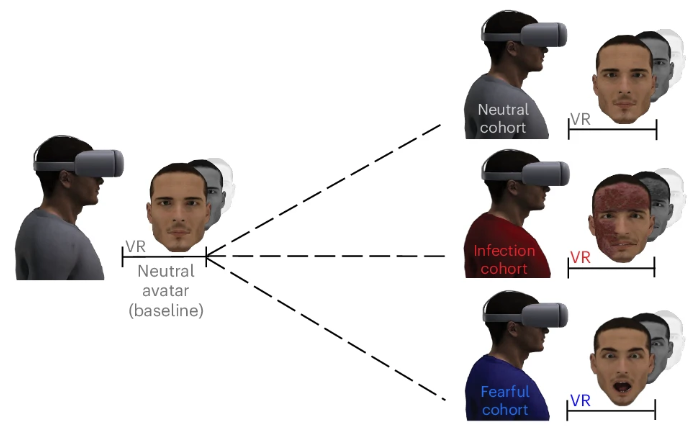
To investigate this, the team designed an experiment using virtual reality.
Participants wore VR headsets and encountered virtual human avatars approaching their bodies. Some avatars appeared neutral. Others displayed fearful expressions. A third group, however, showed clear signs of sickness — pale skin, visible symptoms, and cues associated with infectious disease.
Participants were first exposed to a neutral avatar (baseline) and then assigned to one of three cohorts encountering neutral, infectious, or fearful avatars in a second session.
The researchers then measured responses across multiple biological levels:
behavior,
brain activity using EEG and fMRI,
immune markers in blood samples,
and changes in immune cell activation.
This was not merely a psychology experiment.
It was an attempt to observe the conversation between perception, prediction, and immunity itself.
The Brain Reacted Before “Infection” Arrived
The first results were behavioral.
Participants instinctively avoided the infectious avatars more strongly than neutral or fearful ones. But something even more interesting emerged: the brain responded to infectious avatars at farther distances.
Normally, the PPS system activates most strongly when objects come close enough to potentially touch the body. But the presence of disease cues appeared to expand this protective boundary outward.
It was as though the brain widened its safety perimeter in anticipation of contamination.
Electroencephalography revealed anticipatory neural activity in multisensory–motor brain regions associated with the PPS system. Functional MRI further showed activation in the salience network — brain circuits involved in detecting biologically important events.
The brain was not merely seeing sickness.
It was treating potential infection as an approaching survival threat.
The Most Astonishing Discovery
Then came the truly surprising finding.
The researchers discovered that merely interacting with virtual infectious avatars altered immune-related activity in the body. Specifically, the experiment triggered changes in innate lymphoid cells (ILCs), important early responders in the immune system.
To understand how unusual this was, the researchers compared these responses to a separate group of participants who had received an influenza vaccine — an actual biological immune challenge.
The result was extraordinary.
The immune changes triggered by virtual infection threats resembled aspects of the response seen after real pathogen exposure more strongly than responses to neutral or fearful avatars.
In other words, the body was beginning to prepare for infection before infection itself existed.
The brain does not simply react to the world in real time. Neural processing itself takes time, and yet humans interact with fast-moving environments remarkably efficiently. To solve this problem, the brain continuously predicts future states of reality.
When catching a ball, your brain estimates trajectory before the ball arrives. When walking through a crowd, your nervous system predicts movement patterns milliseconds ahead of time. Even our perception of time itself may partly emerge from predictive neural mechanisms.
What Trabanelli et al. suggest is that this predictive architecture extends beyond perception and movement into immunity itself.
The immune system may not simply be a reactive defense network. It may participate in a broader anticipatory survival system coordinated by the brain.
From an evolutionary standpoint, this makes profound sense.
A false-positive response wastes energy.
A false-negative response may allow infection to spread unchecked.
Natural selection, therefore, favors organisms capable of erring on the side of caution.
Your discomfort around illness, your instinctive distancing behaviors, even subtle emotional reactions to signs of disease may all be part of an ancient predictive survival strategy operating beneath conscious awareness.
Virtual Reality Revealed Something Deeply Human
One of the most fascinating aspects of the study is that the triggering stimulus was not real infection.
It was virtual reality.
The pathogens were simulated. The danger was artificial. Yet the brain and immune system still responded in meaningful ways.
This reveals something profound about human biology.
The body does not wait for perfect certainty.
Instead, it responds to credible predictions of danger.
In many ways, the brain behaves less like a passive camera and more like a continuously running simulation engine — constantly generating forecasts about threats, opportunities, and survival outcomes.
Virtual reality became a powerful scientific tool precisely because it allowed researchers to probe this boundary between perception and biology. The experiment demonstrated that carefully designed sensory cues could engage systems linking the nervous system, immune responses, and behavioral defenses.
The mind and body are not separate systems communicating occasionally.
They are deeply entangled layers of one predictive organism.
Survival Begins Before Contact
The traditional image of the immune system is one of reaction: invaders enter, defenses mobilize, and the body fights back.
But studies like this suggest something more sophisticated.
Humans evolved not merely to respond to threats, but to anticipate them.
Long before a pathogen enters the body, the brain may already be:
evaluating danger,
adjusting behavior,
expanding protective boundaries,
activating salience networks,
and quietly preparing immune defenses.
Survival, it seems, begins at the edge of perception itself.
Between the external world and the body lies an invisible frontier — a predictive boundary where the brain continuously asks one ancient evolutionary question:
Is danger approaching? or in pop-culture terms, ‘Winter’s coming.’
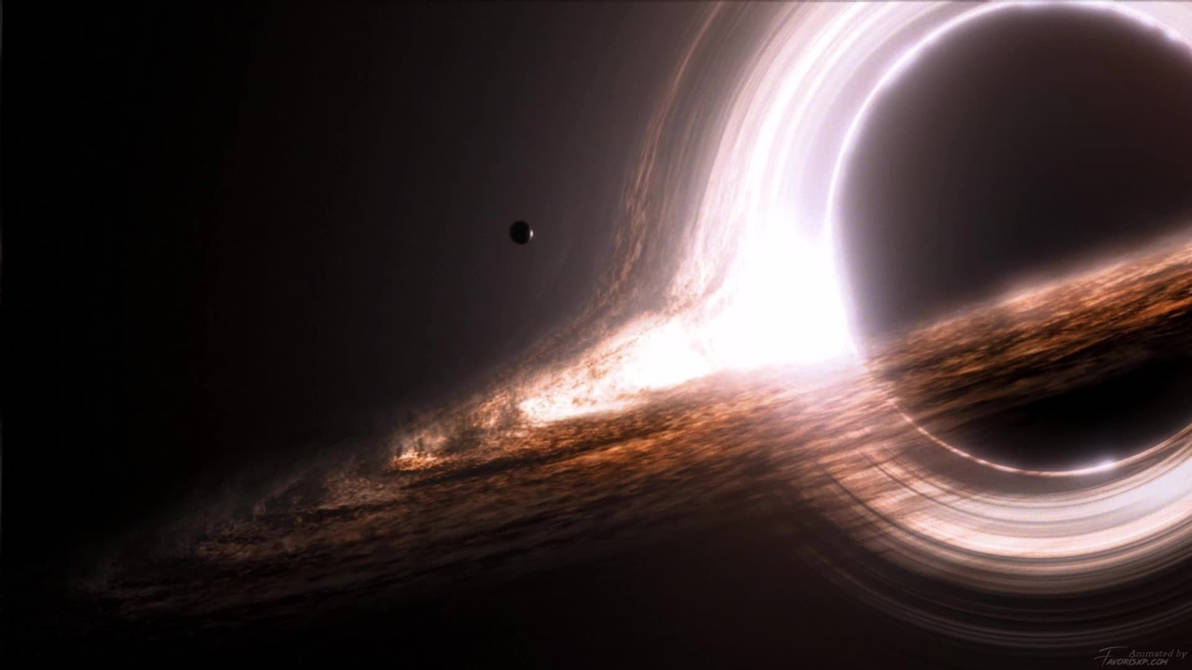
In the movie Interstellar, the positioning of the planets that the team sets out to explore presents an intriguing idea. At one point, it is suggested that life may not have emerged on these planets because of their proximity to a black hole. The film does not explore this in depth—but that is precisely what this article sets out to do.
The Universe as Information
The lens of this discussion is the law of conservation of information, a fundamental principle of quantum mechanics that states information about the quantum state of a physical system can never be destroyed. While this idea leads to the famous black hole information paradox, one proposed resolution—the holographic principle—offers a compelling perspective.
The holographic principle, as proposed by Gerard ‘t Hooft and Leonard Susskind, states that all information falling into a black hole is stored on its 2D boundary (event horizon) surface, allowing information to be encoded in outgoing radiation.
Interestingly, Leonard Susskind also contributed to Interstellar, helping shape the mathematical realism behind its depiction of black holes.
Flow—and Restriction—of Information
We rarely think of the universe in terms of information, but that is, in many ways, what it is.
Every particle carries state. Every interaction transfers something—energy, momentum, structure. Light, perhaps the most fundamental of these carriers, connects distant points in space-time. It tells one part of the universe what is happening in another.
In that sense, the universe is constantly exchanging information with itself. But this exchange is not uniform.
There are places where information flows freely—signals travel, interactions propagate, structures influence one another across space and time. And then there are places where that flow begins to constrict.
A black hole is where this constriction seems to become absolute, with even light unable to escape, hence the name “black hole.”
Now, within the holographic principle, it is not that nothing exists—it is that nothing can reach us. And that changes the nature of what can emerge.
Because complexity is not just about what exists. It is about what can interact.
Randomness Is Not Enough
It is easy to look at life and feel that it must have been intended.
There is rhythm in it. Direction. A quiet sense of continuity. Cells divide, organisms grow, and ecosystems balance themselves with a precision that feels almost deliberate.
It doesn’t quite resemble chaos.
And yet, if we strip it down to its foundations, life begins not with intention, but with randomness. However, randomness is a universal facet of our universe, and yet life is not.
So why does life exist at all?Why here, and not everywhere?When does randomness begin to matter?
The Need for Freedom
Randomness, on its own, is not enough.
It needs room. It needs freedom to explore different possibilities, to try, fail, and try again without being erased too quickly. In other words, it needs access.
Imagine trying to build something intricate—a machine, a language, a living system—but with only a limited set of signals, limited interactions, limited feedback. The possibilities shrink, not because the universe forbids them outright, but because it does not provide enough pathways to arrive there. Randomness is still present. Events still occur. But they repeat within a narrower frame. The system begins to favor simplicity—not by design, but by constraint.
A Planet Like Earth – When Randomness Starts to Remember
Now, step away from that edge of the cosmos and consider a place like Earth. Here, information flows.
Light from the Sun arrives steadily, carrying energy across space. The atmosphere filters, scatters, and redistributes it. Molecules collide, react, recombine. Oceans circulate heat. Geological processes reshape the surface. Nothing is still, but nothing is overwhelmingly destructive either.
It is not chaos. It is not stability. It is something in between.
A kind of balance where interactions are rich, but not immediately erased. Where variations can persist long enough to matter. In such a place, randomness behaves differently. It does not just produce outcomes—it begins to accumulate them.
Atoms collide. Bonds form and break. Energy moves. A molecule forms and remains intact. It participates in another reaction. A chain develops. A structure stabilizes. Each step does not disappear entirely; it leaves behind a trace, something that can be built upon.
We call that life.
Seen this way, life is not an exception to randomness. It is a consequence of it—but only under the right conditions. Not all randomness leads to complexity. Only the kind that is allowed to explore, interact, and persist does. And that depends on the nature of the universe around it.
Back to Interstellar
This brings us back to Interstellar and the position of the planets. The planets – Miller’s and Mann’s orbit the black hole, Gargantua.
The movie shows the effects of this proximity – while Miller’s planet has extreme gravity and experiences 4,000-foot tidal waves along with severe time dilation (7 years per minute), Mann’s planet is a frozen wasteland with limited light, featuring ice clouds and a rocky, cold surface.
Now, in theory, both these planets, sometimes called “blanets” (black hole planets), were in what’s called a safe zone – a stable last orbit for matter, allowing for orbits that do not instantly spiral into the singularity.
But stability alone is not enough.
As we have seen, what matters is not just existence, but freedom of interaction.
Near a black hole, this freedom is constrained. Information flow is limited. Interaction pathways are restricted. As a result, complexity struggles to emerge. Miller’s planet ends up with water, and Mann’s planet goes as far as ammonia, carbon dioxide, and ammonium hydrosulfide or similar ammonia-sulfur compounds. But complexity never truly takes off.
A Selective Universe
The cosmos is not uniform in its generosity. Some regions are too quiet—too little interaction, too little variation. Others are too violent—too much disruption, too little continuity. And then there are rare pockets where the balance holds just enough for complexity to take root.
Not guaranteed. Not directed. But possible.
The Quiet Realization
It is tempting to think of life as something that inevitably emerges given enough time.
But perhaps it is more accurate to think of it as something that emerges where time, interaction, and accessible possibility align.
Where the universe is not just active—but permissive.
In Closing
There is something quietly humbling in that thought.
Life is not just about the presence of matter or energy. It is about the freedom to connect, to exchange, to build on what came before.
Modern cars are extraordinary machines. Not just because they can travel hundreds of kilometers on a tank of fuel or glide silently on electric power, but because of the sheer amount of science quietly working beneath the surface. And yet, most of the truly impressive engineering in a car is hidden in the features we barely notice.
Consider how often we admire horsepower, acceleration, or the sleekness of design. But rarely do we pause to think about the small conveniences and safety mechanisms that operate silently in the background, features that have become so reliable that they now feel mundane.
Two such examples are the auto-dimming rear-view mirror and the Anti-lock Braking System (ABS). Both are now standard in many vehicles, both operate almost invisibly, and both are excellent illustrations of how physics, chemistry, and control systems merge to solve everyday problems.
When Chemistry Reduces Glare
Imagine driving at night on a dark highway. A car behind you suddenly switches on its high beams, and the glare floods your rear-view mirror. In older cars, you would manually flip the mirror to reduce the reflection. In many modern vehicles, however, the mirror dims automatically.
The first commercial application of electrochromism in rear-view mirrors was introduced by Gentex Corporation in 1987, which debuted as an interior auto-dimming rear-view mirror on the 1988 Lincoln Continental.
This small act of convenience is powered by a fascinating bit of materials science known as electrochromism.
Auto-dimming mirrors contain two layers of glass with a thin electrochromic gel sandwiched between them. Light sensors monitor both the ambient light in front of the vehicle and the intensity of light hitting the mirror from behind. When the rear sensor detects a strong light source—like high beams from another car—a small electrical voltage is applied across the electrochromic layer.
This voltage triggers a chemical change in the material, altering how it absorbs and reflects light. As electrons shift within the layer, the mirror darkens, reducing glare and improving the driver’s visibility.
There are no motors, no mechanical movement—just a subtle change in the electronic state of the material itself. In essence, the mirror doesn’t move to block the light; it changes its optical properties to absorb it.
Behind this simple comfort feature lies a carefully engineered balance between chemistry, optics, and human physiology. Our eyes adapt slowly to sudden brightness, especially at night. By automatically reducing glare, the mirror compensates for this limitation in human vision.
What appears to be a small convenience is actually a quiet collaboration between materials science and human-centered design.
Automatic dimming on the inner rear-view mirror of a 1987-issue Oldsmobile Toronado Troféo. On the left is the rotary knob for sensitivity adjustment, on the right the phototransistor and the on/off switch.
When Physics Saves Control: The Engineering of ABS
If auto-dimming mirrors represent elegance in chemistry, ABS represents elegance in physics and control engineering.
To understand ABS, we need to look at a fundamental problem in braking.
When drivers panic, the natural instinct is to slam the brake pedal as hard as possible. In older braking systems, this often caused the wheels to lock completely. A locked wheel stops rotating and begins sliding across the road surface.
At first glance, that might seem like maximum braking force. In reality, it is the opposite.
Physics tells us that static friction, the friction between two surfaces that are not sliding relative to each other, is stronger than kinetic friction, which occurs when surfaces slide past one another. When a tire rolls while gripping the road, it benefits from static friction. When it locks and slides, it transitions into weaker kinetic friction.
This loss of traction creates two problems. First, braking efficiency decreases. Second, and more dangerously, the driver loses the ability to steer. A sliding tire cannot respond effectively to steering inputs.
ABS solves this problem by preventing the wheels from locking in the first place.
Wheel-speed sensors constantly monitor how fast each wheel is rotating. If the system detects that a wheel is slowing down too rapidly, an early sign that it may lock, the ABS controller momentarily reduces the brake pressure on that wheel. Once the wheel begins rotating again, the system reapplies the braking force.
This cycle repeats extremely quickly, often dozens of times per second. The driver feels this as a slight pulsing in the brake pedal during hard braking.
What ABS is really doing is maintaining the delicate balance where the tire remains at the edge of traction, while preserving steering control.
In effect, ABS is a real-time physics engine embedded in the car. It observes, calculates, and intervenes faster than any human could react.
Mercedes-Benz and Bosch introduced the first electronic, four-channel ABS on the Mercedes-Benz S-Class in the 1970s.
Bosch ABS-2 anti-lock brake controller, on display at the Computer History Museum, California, USA.
What makes these technologies particularly interesting is how little we notice them.
Auto-dimming mirrors rarely draw attention to themselves. ABS activates only during emergency braking. Most of the time, they sit quietly in the background, performing their roles without ceremony.
This is often the hallmark of mature engineering.
The early days of a technology are noisy. New inventions are celebrated, discussed, and admired. Over time, as they become reliable and widely adopted, they fade into the background of daily life.
We stop noticing them, not because they are unimportant, but because they work so well.
The Quiet Genius of Everyday Machines
Modern cars contain countless such examples: crumple zones designed to absorb impact energy, airbags that deploy through precisely timed chemical reactions, traction control systems that manage tire grip in slippery conditions, and more.
Each of these represents decades of scientific understanding translated into practical design.
Yet perhaps the most impressive aspect of all is not the complexity of the technology itself, but the way it integrates seamlessly into everyday experience. The best engineering rarely demands attention. It simply makes life safer, smoother, and more predictable.
So the next time your rear-view mirror dims automatically or your car maintains control during sudden braking, it may be worth pausing for a moment.
What feels ordinary is, in fact, the quiet triumph of science.
“Work smart, not hard” has become one of the most repeated pieces of professional advice. It usually carries an implicit promise: there exists a clever shortcut that will save you time, energy, or discomfort.
Sometimes, that promise is true. Automation, better tools, experience, and process improvements genuinely reduce effort. But the mistake lies in assuming that smart work always means less work.
In many situations—especially early in one’s career or when entering a new domain—there is no less-effort path. There is only the work.
The Problem With the Shortcut Definition
The popular interpretation of smart work is task-centric:
Can I finish this faster?
Can I avoid this step?
Can I optimize this process?
These are valid questions, but they are also narrow. They assume that the purpose of work is merely to complete a task.
But work, especially meaningful work, is rarely just about completion. It is also about:
Skill acquisition
Pattern recognition
Judgment formation
Decision-making under uncertainty
None of these emerge from shortcuts alone.
A More Honest Definition of Smart Work
A more realistic definition of smart work is this: “Smart work is effort that compounds.“
It is not about how little energy you expend today, but about whether today’s effort takes you to a higher baseline tomorrow.
Sometimes, smart work looks like:
Doing the same task repeatedly until you understand it deeply
Investing extra time to learn why something works, not just how
Choosing a slower path because it builds transferable skills
In this sense, smart work is not the opposite of hard work. It is “hard work with direction.”
Smart work becomes clearer when we move away from professions where “optimization” is obvious and look at roles where effort cannot easily be reduced.
Take a security guard or a gatekeeper. There is no faster way to “guard” a gate, no clever hack to replace vigilance. Yet smart work exists even here: not in doing less, but in seeing more. Over time, a good guard begins to recognize patterns: who belongs, what normal looks like, when something feels off. The work does not change, but the depth of perception does.
The same is true for a factory worker on an assembly line. While the motion may be repetitive, understanding the machine, anticipating faults, noticing inefficiencies, or maintaining consistency under pressure transforms the worker from someone who merely performs a task into someone who masters a process.
A junior software engineer may write code that works, but smart work lies in learning how systems scale, why decisions were made, how failures propagate —skills that are invisible in the short term but decisive over a career.
Even in professions like teaching or nursing, where care and presence cannot be optimized away, smart work emerges through experience: reading people better, responding calmly under stress, knowing when to intervene and when to step back.
Across these roles, smart work is not about reducing effort; it is about accumulating judgment. It is the quiet, often unnoticed process of becoming better at the same work—until one is ready, naturally, for the next level.
Progress, Not Comfort, Is the Metric
Smart work should be evaluated not by immediate ease, but by progression:
Are you better at this than you were last month?
Are you faster because you’re skilled, not because you skipped steps?
Are you moving toward more complex, meaningful problems?
When someone becomes exceptionally good at a task, speed follows naturally. At that point, finishing faster isn’t the goal; it’s a side effect. The real win is that you’re now ready for the next layer of responsibility.
That transition from execution to ownership, from instruction to intuition, is the truest marker of smart work.
When Smart Work Looks Like Hard Work
There are phases in life where smart work is indistinguishable from hard work:
Learning a new discipline
Building foundational skills
Starting something from scratch
In these phases, avoiding effort is not intelligence, it is avoidance.
Smart work here is about endurance with awareness:
Paying attention to feedback
Refining technique
Building mental models
Letting effort shape competence
Work as a Vehicle, Not a Burden
Perhaps the biggest shift in thinking is this: Smart work is not about escaping work, it is about using work as a vehucle for:
Growth
Self-discovery
Capability expansion
Earning optionality
When seen this way, effort is not something to minimize blindly, but something to invest wisely.
In Closing
Smart work is not the art of doing less. It is the discipline of ensuring that whatever you do today moves you forward.
Sometimes that means finding a smarter method. Sometimes it means doing the work so well that the next step reveals itself.
Both are smart. Avoiding effort, however, rarely is.
As we celebrate the 1st of January and mark the beginning of another year, it’s easy to forget that this date is not as “natural” as it feels. The calendar we follow today is not the result of cosmic alignment or seasonal logic alone, but of political decisions, administrative convenience, and centuries of gradual correction. In fact, January was not always the first month of the year—and at one point, it didn’t exist at all.
The earliest Roman calendar, traditionally attributed to Romulus, consisted of just ten months. The year began in March, a fitting choice for an agrarian society. Spring marked the return of warmth, the start of planting, and the resumption of military campaigns. The calendar ran from March to December, after which came an uncounted winter period—a stretch of days that simply didn’t belong to any month.
This origin story is still embedded in the calendar’s language. September, October, November, and December derive from the Latin septem, octo, novem, and decem—seven, eight, nine, and ten. Their names made perfect sense when March was month one. The fact that they now appear as months nine through twelve is a historical artifact, not a logical design.
January and February were added later, around the 7th century BCE, during the reign of Numa Pompilius. The Romans realized that ignoring winter entirely was administratively inconvenient. Time still passed, debts still accrued, and rituals still needed dates. So two months were appended to the calendar—placed at the end of the year. January and February were originally after December, not before March.
January itself takes its name from Janus, the Roman god of doorways, transitions, and beginnings. Janus is famously depicted with two faces—one looking backward and the other forward. The symbolism was apt, but symbolism alone did not make January the start of the year.
That shift came later, driven not by astronomy but by bureaucracy. In 153 BCE, Rome decided that newly elected consuls would assume office on January 1st rather than in March. This change helped synchronize military command, taxation, and governance. Over time, administrative reality overtook tradition. When the Gregorian calendar was formalized centuries later, January 1st was already functioning as the practical start of the year—and it remained so.
The names of other months tell a similar story of power, politics, and legacy. July was originally Quintilis—the fifth month—until it was renamed in honor of Julius Caesar, whose calendar reforms brought much-needed structure to Roman timekeeping. August, once Sextilis, was renamed after Augustus Caesar, ensuring that two emperors would permanently occupy the calendar.
The remaining months preserve older Roman associations: April may derive from aperire, meaning “to open,” reflecting springtime renewal. May is linked to Maia, a goddess associated with growth. June is often associated with Juno, protector of marriage and family.
None of these names were chosen all at once, nor according to a single guiding philosophy. The calendar evolved through patchwork fixes, layered reforms, and pragmatic decisions made by people trying to manage societies—not time itself.
What we celebrate on January 1st, then, is not just the turning of a year, but the success of a long-standing administrative agreement. A shared understanding that this is where we pause, reset, and begin again.
In a way, the calendar reflects something deeply human. We impose structure on continuity. We draw lines on an unbroken flow of days and give them meaning. The “new year” is not a natural boundary—but it has become a powerful one, precisely because we all agree to treat it as such.
So as the year turns, it’s worth remembering: January did not begin the year because nature demanded it. It began because people needed a beginning—and decided this would be it.
And perhaps that’s fitting. Every new year is, in the end, a collective act of belief.
This is personal. My mother passed away suddenly, the day after my marriage. One moment she was there, handing my father a cup of tea, and the next moment she was gone—taken by a heart attack.
I didn’t know what to do then, and even today, I often find myself thinking: what could I have done differently? Could she still be here if I had acted faster, or known more? Yet, being a seeker of spirituality, I also hold a belief that helps me endure: it is what it is. Events happen as causes and effects. We cannot cling, we cannot resist. We can only accept, and then seek to understand.
That seeking led me to the question: why did it happen?
Doctors called it a myocardial infarction—but that is only the medical description of what occurred, not the root cause. It is the scientific label for the event, not the story behind it. And that deeper question of “what caused it” has been on my mind ever since.
A Larger Pattern
If you’ve followed the news in India lately—beyond politics—you may have noticed a troubling trend. There has been a rise in deaths caused by heart attacks. Old, young, seemingly healthy—none seem spared.
One case that caught national attention was Nithin Kamath, a well-known entrepreneur admired for his fitness. In his case, thankfully, he suffered a mild stroke, not a heart attack (myocardial infarction), in early 2024. His story underscores something crucial: a heart attack is not always about age, lifestyle, or obvious risk—it can strike anyone.
Medical research tells us there are many contributing factors:
High blood pressure, diabetes, and cholesterol imbalances
And more often than not, it’s not just one, but a unique combination of these factors that makes the heart vulnerable.
But there is another factor, one that deserves much more attention: what happens after the heart attack begins.
The Crucial Factor: CPR
Studies across the world show a simple, powerful truth: when more people around a heart attack victim know CPR, survival rates rise dramatically. Early intervention can make the difference between life and death.
According to a review published in the Indian Heart Journal, the bystander CPR rate in India is only 1.3%–9.8%, far below the target goal of 62% set by the American Heart Association Emergency Cardiovascular Care. Add to it the lack of robust emergency medical services, and you get a survival rate of less than 10% for Out-of-hospital cardiac arrest.
That’s why I want to make this a call to action: please learn CPR, specifically chest compressions. There are excellent YouTube tutorials and guides that explain it clearly—here’s one from the Red Cross. Watch it, share it, and pass this knowledge forward. One day, you may save someone’s life.
I also believe this must be institutionalized. We should mandate CPR training for young adults in schools nationwide. In 2022, Dr Shrikant Eknath Shinde, Member of Parliament, proposed a bill in the Lok Sabha requiring CPR training for schools in India to reduce the high fatalities due to cardiac arrest. The status of this bill is currently unknown.
It’s not just skill-building, it’s life-saving.
My Mother’s Story
Even with these broader reflections, I keep circling back to my mother. What really caused her heart to fail that day?
Looking back, there were unique factors in play:
It was December, the harsh winter in North India.
She had been deeply involved in the wedding preparations for weeks.
She had recently traveled between two cities, once by bus and once by flight.
She was physically exhausted, as most of us were.
But there was something more. Her mental state.
When I last saw her, she was radiating joy—her face was glowing. She had just seen her son get married, her family gathered, her heart full. And in that state of absolute happiness, she collapsed.
This leads me to an educated guess: she may have suffered what is known as Happy Heart Syndrome. Medically, it’s a form of stress cardiomyopathy, more commonly linked to grief or shock (“Broken Heart Syndrome”), but documented also in cases of overwhelming joy.
Her physical exhaustion, the environmental strain, and her heightened emotional state together may have triggered the fatal event.
It is, in a way, a poetic answer. But I think it is also a reasonable one.
Closing Reflection
I share this not to dwell in grief, but in understanding. We may not always have clear answers—sometimes there is absence of evidence. But absence of evidence is not evidence of absence.
Science and spirituality both remind us of this truth. Science helps us search for causes, build probabilities, and act smarter in the future. Spirituality reminds us to accept what we cannot change, to see the beauty even in endings.
For my mother, I choose to believe she left this world not in pain, but in joy. That glowing face is the memory I hold. And perhaps that is how the heart too works; it beats with us in sorrow, in stress, and sometimes, it can’t contain overwhelming happiness either.