Category: Open Science

  • Your First Line of Defense – The Predictive Brain and the Biology of Survival

    Your First Line of Defense – The Predictive Brain and the Biology of Survival

    A person sneezes beside us, and we subtly lean away. Someone visibly ill enters a room, and the atmosphere changes before a single word is spoken. Even without medical knowledge, our bodies seem to react to the possibility of infection.

    Similarly, during the COVID-19 pandemic, something unusual happened to human behavior. Long before many governments imposed restrictions, people had already begun stepping away from coughing strangers, avoiding crowded elevators, and instinctively creating distance between themselves and others. Some of this was conscious reasoning. But much of it felt automatic — almost ancient.

    Why?

    For years, scientists have understood the immune system as something that reacts after pathogens enter the body. Germs invade, immune cells mobilize, and the battle begins. But what if survival starts even earlier than that? What if the brain itself acts as an early warning system, preparing the body for infection before physical contact even occurs?

    A study published in Nature Neuroscience by Sara Trabanelli and colleagues at the University of Lausanne suggests exactly that. Their research proposes something extraordinary: the human brain may begin activating components of the immune system simply by anticipating contact with disease.

    Evolution Built More Than an Immune System

    From an evolutionary perspective, waiting for infection is a risky strategy.

    Pathogens reproduce quickly. A delayed response can mean death. Across millions of years, social species therefore evolved behaviors designed not merely to fight disease, but to avoid it altogether. Scientists sometimes refer to this collection of instincts as the behavioral immune system.

    This system includes:

    • avoidance of visibly sick individuals,
    • disgust reactions,
    • caution around contaminated food, and
    • even social distancing behaviors

    In many ways, prevention is biologically cheaper than repair. The age-old saying, prevention is better than cure, probably has deeper evolutionary origins.

    A fascinating aspect of evolution is that it often prioritizes false alarms over missed threats. Mistakenly avoiding a healthy person costs little. Failing to avoid an infectious individual may cost survival itself. As a result, the human brain evolved to become exquisitely sensitive to signs that resemble disease, even before infection is confirmed.

    But this raises a deeper question.

    Could the brain merely be influencing behavior? Or could it actually be communicating with the immune system itself?

    The Brain’s Invisible Protective Bubble

    To understand the study, we first need to understand one of the strangest features of the human brain: the invisible safety boundary surrounding the body.

    Neuroscientists call this the peripersonal space (PPS) system.

    The PPS is essentially the brain’s constantly updated map of the immediate space around us — the zone where outside objects may soon touch the body. Specialized fronto-parietal brain networks continuously integrate:

    • visual information,
    • sounds,
    • touch,
    • and movement

    to predict potential contact with nearby objects.

    This system quietly governs countless everyday experiences.

    When a ball flies toward your face, you flinch before impact. When someone stands too close behind you, discomfort emerges almost instantly. When a fast-moving object approaches, your body prepares for action before conscious thought catches up.

    The brain is not passively observing reality.

    It is constantly predicting what may happen next.

    And according to Trabanelli et al., infection may be treated as another form of approaching threat.

    Can the Brain Detect Infection Before Contact?

    The researchers asked a remarkable question:

    Could the human brain detect the possibility of infection early enough to trigger an anticipatory immune response?

    To investigate this, the team designed an experiment using virtual reality.

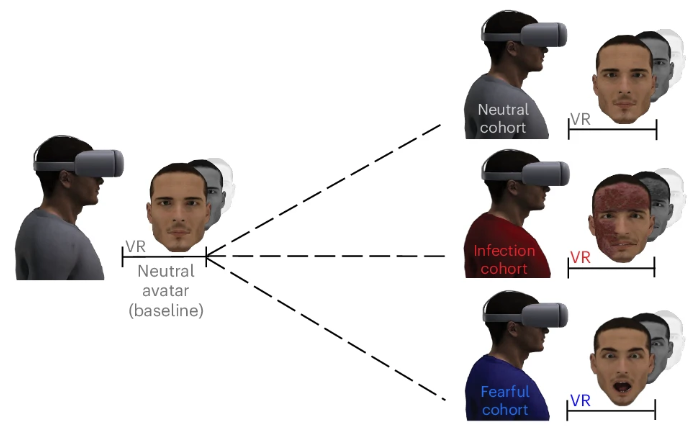
    Participants wore VR headsets and encountered virtual human avatars approaching their bodies. Some avatars appeared neutral. Others displayed fearful expressions. A third group, however, showed clear signs of sickness — pale skin, visible symptoms, and cues associated with infectious disease.

    Participants were first exposed to a neutral avatar (baseline) and then assigned to one of three cohorts encountering neutral, infectious, or fearful avatars in a second session.

    Source: https://www.nature.com/articles/s41593-025-02008-y/figures/1.

    The researchers then measured responses across multiple biological levels:

    • behavior,
    • brain activity using EEG and fMRI,
    • immune markers in blood samples,
    • and changes in immune cell activation.

    This was not merely a psychology experiment.

    It was an attempt to observe the conversation between perception, prediction, and immunity itself.

    The Brain Reacted Before “Infection” Arrived

    The first results were behavioral.

    Participants instinctively avoided the infectious avatars more strongly than neutral or fearful ones. But something even more interesting emerged: the brain responded to infectious avatars at farther distances.

    Normally, the PPS system activates most strongly when objects come close enough to potentially touch the body. But the presence of disease cues appeared to expand this protective boundary outward.

    It was as though the brain widened its safety perimeter in anticipation of contamination.

    Electroencephalography revealed anticipatory neural activity in multisensory–motor brain regions associated with the PPS system. Functional MRI further showed activation in the salience network — brain circuits involved in detecting biologically important events.

    The brain was not merely seeing sickness.

    It was treating potential infection as an approaching survival threat.

    The Most Astonishing Discovery

    Then came the truly surprising finding.

    The researchers discovered that merely interacting with virtual infectious avatars altered immune-related activity in the body. Specifically, the experiment triggered changes in innate lymphoid cells (ILCs), important early responders in the immune system.

    To understand how unusual this was, the researchers compared these responses to a separate group of participants who had received an influenza vaccine — an actual biological immune challenge.

    The result was extraordinary.

    The immune changes triggered by virtual infection threats resembled aspects of the response seen after real pathogen exposure more strongly than responses to neutral or fearful avatars.

    In other words, the body was beginning to prepare for infection before infection itself existed.

    Not after a virus entered the bloodstream.

    Not after tissue damage.

    But during the anticipation of possible contact.

    Your Brain Is a Prediction Machine

    This idea aligns beautifully with one of the central themes explored previously on The Critical Thought in the article From Catching a Ball to Catching Time: A Journey Through the Brain’s Perception Engine

    The brain does not simply react to the world in real time. Neural processing itself takes time, and yet humans interact with fast-moving environments remarkably efficiently. To solve this problem, the brain continuously predicts future states of reality.

    When catching a ball, your brain estimates trajectory before the ball arrives. When walking through a crowd, your nervous system predicts movement patterns milliseconds ahead of time. Even our perception of time itself may partly emerge from predictive neural mechanisms.

    What Trabanelli et al. suggest is that this predictive architecture extends beyond perception and movement into immunity itself.

    The immune system may not simply be a reactive defense network. It may participate in a broader anticipatory survival system coordinated by the brain.

    From an evolutionary standpoint, this makes profound sense.

    A false-positive response wastes energy.

    A false-negative response may allow infection to spread unchecked.

    Natural selection, therefore, favors organisms capable of erring on the side of caution.

    Your discomfort around illness, your instinctive distancing behaviors, even subtle emotional reactions to signs of disease may all be part of an ancient predictive survival strategy operating beneath conscious awareness.

    Virtual Reality Revealed Something Deeply Human

    One of the most fascinating aspects of the study is that the triggering stimulus was not real infection.

    It was virtual reality.

    The pathogens were simulated. The danger was artificial. Yet the brain and immune system still responded in meaningful ways.

    This reveals something profound about human biology.

    The body does not wait for perfect certainty.

    Instead, it responds to credible predictions of danger.

    In many ways, the brain behaves less like a passive camera and more like a continuously running simulation engine — constantly generating forecasts about threats, opportunities, and survival outcomes.

    Virtual reality became a powerful scientific tool precisely because it allowed researchers to probe this boundary between perception and biology. The experiment demonstrated that carefully designed sensory cues could engage systems linking the nervous system, immune responses, and behavioral defenses.

    The mind and body are not separate systems communicating occasionally.

    They are deeply entangled layers of one predictive organism.

    Survival Begins Before Contact

    The traditional image of the immune system is one of reaction: invaders enter, defenses mobilize, and the body fights back.

    But studies like this suggest something more sophisticated.

    Humans evolved not merely to respond to threats, but to anticipate them.

    Long before a pathogen enters the body, the brain may already be:

    • evaluating danger,
    • adjusting behavior,
    • expanding protective boundaries,
    • activating salience networks,
    • and quietly preparing immune defenses.

    Survival, it seems, begins at the edge of perception itself.

    Between the external world and the body lies an invisible frontier — a predictive boundary where the brain continuously asks one ancient evolutionary question:

    Is danger approaching? or in pop-culture terms, ‘Winter’s coming.’

  • The Fire Within the Forest: What Redwoods Reveal About Nature’s Code

    The Fire Within the Forest: What Redwoods Reveal About Nature’s Code

    Some stories in nature seem too poetic to be real—like fables written by evolution. The towering redwoods of California are one such story. Standing as giants among trees, they appear serene and invincible. But their stillness hides an ancient, ruthless logic—a deep lesson about the ways of nature.

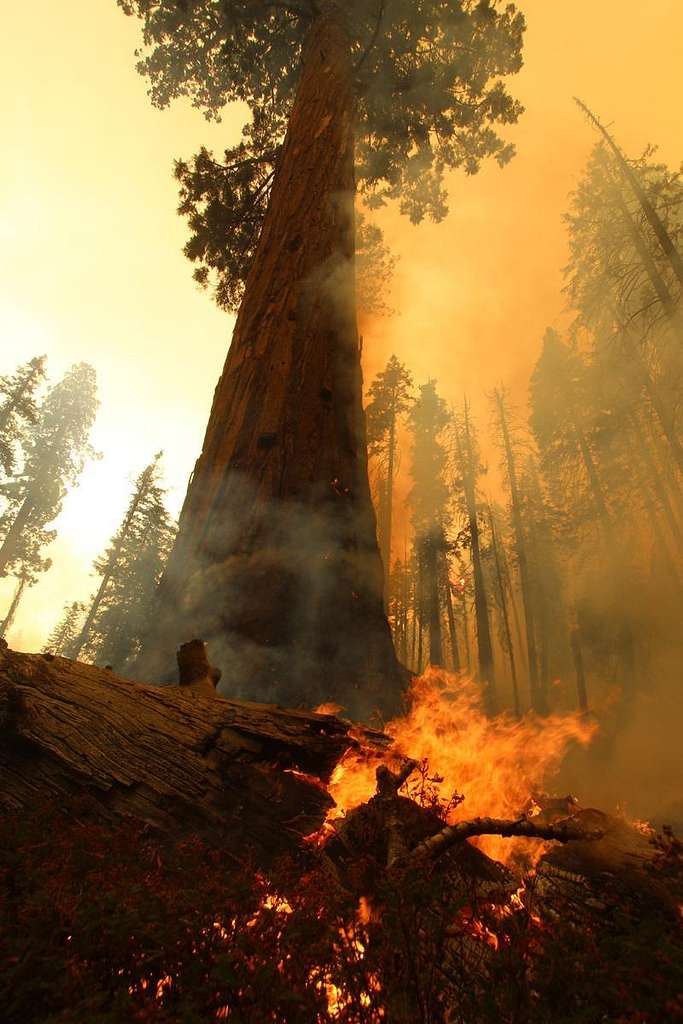
    In 2020, the wildfires that raged through California’s Big Basin Redwoods State Park painted a grim picture. Centuries-old trees, some with trunks as wide as small cars, were charred and stripped bare. Yet many of these same trees, seemingly lifeless, would survive. Not by miracle, but by design. Redwood trees, it turns out, don’t just survive fire—they use it.

    The redwoods not only grow tall enough to attract lightning, but also possess an extraordinary resistance to fire. Like lightning rods on tall buildings, these traits reflect nature’s engineering at its finest: a co-evolved strategy where fire isn’t a threat, but an ally in the tree’s survival and regeneration.

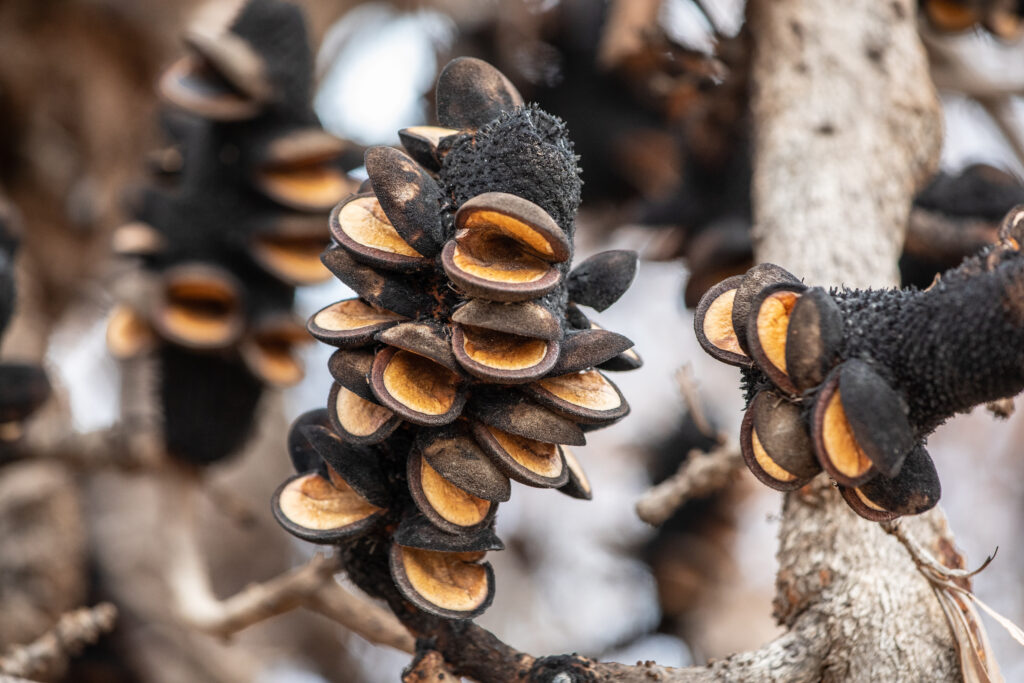
    The bark of a redwood contains high levels of tannins, natural flame retardants that protect it from intense heat. Unlike other trees that might succumb to flames, redwoods often remain standing, scarred but alive. Their cones—serotinous by design—only open under the intense heat of fire, releasing seeds into a forest floor freshly cleared of competition. Fires not only remove underbrush but enrich the soil with ash and nutrients, creating optimal conditions for germination. A literal definition of being ‘forged in fire.’

    The serotinous cones of a Banksia tree opened by the Peat Fire in Cape Conran Coastal Park, Victoria. (DOI/Neal Herbert)

    Fire, for the redwood, is not an ending. It’s an opening.

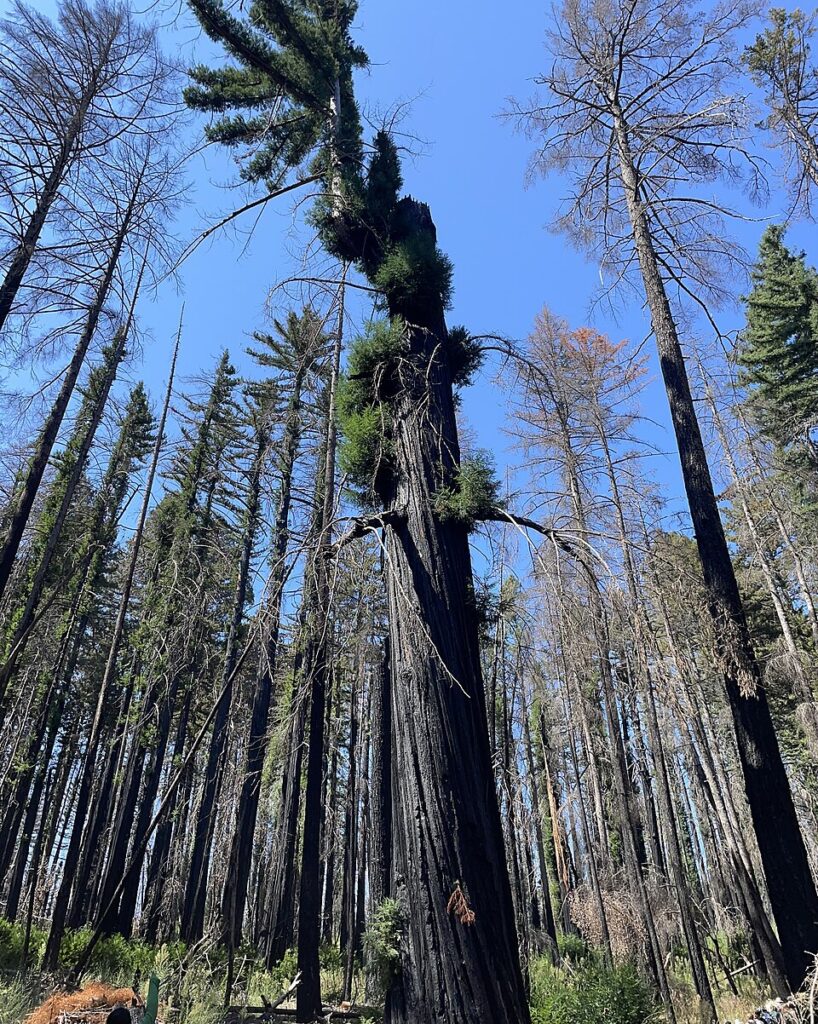
    But perhaps the most astonishing detail emerged in a paper published in Nature Plants following the 2020 fires. Researchers discovered that even completely defoliated redwoods could rebound. They did so by drawing on energy reserves—sugars created by photosynthesis decades ago. These reserves fueled the growth of dormant buds, some of which had been lying quietly under bark for over a century, waiting for a cue like this. The phenomenon is known as Epicormic growth. Epicormic growth is the development of shoots from dormant buds beneath the bark of a tree or plant, often triggered by stress or damage. 

    Epicormic growth 2 years after the CZU fire in Big Basin Redwoods State Park

    This might sound awe-inspiring, and it is—but it is not benevolence. It’s strategy. The redwoods are not noble survivors; they are ruthless ones. Their entire structure, from bark to bud, is a system designed not just to endure fire but to leverage it for dominance.

    In this, they echo the lesson we once explored with cuckoo birds—those parasitic strategists that plant their young in the nests of unsuspecting hosts. Like the redwoods, they too reveal that evolution has no moral compass. It selects what survives, not what seems fair. Nature doesn’t ask what should be done. It simply reinforces what works.

    And yet, this story isn’t a celebration of destruction. It’s also a warning. The redwoods evolved with fire, yes—but with fire of a certain kind. Historically, these forests experienced low to moderate intensity burns, often sparked naturally and spaced out over decades. Today, with the human fingerprint heavy on the climate, we’re seeing more intense, more frequent fires—pushed by droughts, temperature rise, and altered landscapes.

    Redwoods are resilient, but even resilience has a threshold. Fires that once cleared underbrush now scorch entire root systems. Seedlings once given an open forest floor must now contend with unstable post-fire landscapes. Survival, even for the mighty redwood, is no longer guaranteed.

    So, what do these trees teach us? First, that survival often lies in counterintuitive strategies. And second, that even the most robust systems have limits when pushed too far. Nature is neither kind nor cruel—it is adaptive. But it is not immune to the consequences of imbalance.

    In the story of redwoods and fire, we see nature’s complexity at its best—but we’re also reminded that when we disrupt the balance, we risk tipping even the most ancient survivors into decline. Understanding nature’s logic is not just about marveling at its design; it’s about recognizing our role in the new story being written.

    And that, perhaps, is where the morality comes in—not in nature, but in us.

  • The Way of Science – Solving the Wild Boar Paradox

    The Way of Science – Solving the Wild Boar Paradox

    The forests of Bavaria, southeastern Germany, are both beautiful and mysterious, harboring a secret that has puzzled scientists for decades. The mystery involves wild boars, creatures deeply embedded in the local ecosystem and culture. Their meat, a traditional delicacy, was found to contain radioactive cesium-137 at levels alarmingly higher than safety regulations allow, even decades after the initial contamination events.

    The story begins with a problem: unlike other forest animals whose cesium-137 levels declined over time, wild boars showed persistent high levels of this radioactive element. This anomaly, dubbed the “wild boar paradox,” seemed to defy the natural laws of radioactive decay. Scientists were intrigued. Why were the wild boars different?

    To solve this paradox, scientists embarked on a journey guided by the fundamental principles of the scientific method: 𝘰𝘣𝘴𝘦𝘳𝘷𝘢𝘵𝘪𝘰𝘯, 𝘩𝘺𝘱𝘰𝘵𝘩𝘦𝘴𝘪𝘴 𝘧𝘰𝘳𝘮𝘶𝘭𝘢𝘵𝘪𝘰𝘯, 𝘦𝘹𝘱𝘦𝘳𝘪𝘮𝘦𝘯𝘵𝘢𝘵𝘪𝘰𝘯, and 𝘢𝘯𝘢𝘭𝘺𝘴𝘪𝘴.

    𝗢𝗯𝘀𝗲𝗿𝘃𝗮𝘁𝗶𝗼𝗻: 𝗔𝗻 𝗨𝗻𝘀𝗼𝗹𝘃𝗲𝗱 𝗠𝘆𝘀𝘁𝗲𝗿𝘆

    The initial observation was clear and troubling. Following the Chornobyl nuclear accident in 1986, cesium-137 levels in Bavarian wild boars remained high, showing little sign of decline. This persistence was unusual compared to other species whose contamination levels decreased over time. The scientists noted that in some areas, the decline in cesium-137 levels was even slower than its physical half-life, a phenomenon that contradicted expectations.

    𝗛𝘆𝗽𝗼𝘁𝗵𝗲𝘀𝗶𝘀 𝗙𝗼𝗿𝗺𝘂𝗹𝗮𝘁𝗶𝗼𝗻: 𝗦𝗲𝗲𝗸𝗶𝗻𝗴 𝗘𝘅𝗽𝗹𝗮𝗻𝗮𝘁𝗶𝗼𝗻𝘀

    The scientists hypothesized that the persistent contamination might be due to a complex interplay of factors, including the origins and movement of cesium-137 in the environment. Bavaria had been subjected to cesium-137 fallout from two primary sources: global atmospheric nuclear weapons testing in the 1960s and the Chornobyl accident in 1986. Could the mixed legacy of these events be the key to understanding the wild boar paradox?

    𝗘𝘅𝗽𝗲𝗿𝗶𝗺𝗲𝗻𝘁𝗮𝘁𝗶𝗼𝗻: 𝗧𝗵𝗲 𝗣𝗼𝘄𝗲𝗿 𝗼𝗳 𝗡𝘂𝗰𝗹𝗲𝗮𝗿 𝗙𝗼𝗿𝗲𝗻𝘀𝗶𝗰𝘀

    To test their hypothesis, the scientists turned to nuclear forensics, a powerful tool for tracing the origins of radioactive materials. They used the ratio of cesium-135 to cesium-137, an emerging forensic fingerprint that can distinguish between different sources of radiocesium. Nuclear explosions tend to yield a relatively high cesium-135 to cesium-137 ratio, while nuclear reactors produce a low ratio.

    By measuring this ratio in wild boar samples, the scientists could determine the relative contributions of cesium-137 from nuclear weapons fallout and the Chornobyl accident. Their findings were revealing: the median contributions of cesium-137 in boars were approximately 25% from weapons fallout and 75% from Chornobyl.

    𝗔𝗻𝗮𝗹𝘆𝘀𝗶𝘀: 𝗣𝗶𝗲𝗰𝗶𝗻𝗴 𝗧𝗼𝗴𝗲𝘁𝗵𝗲𝗿 𝘁𝗵𝗲 𝗣𝘂𝘇𝘇𝗹𝗲

    The results confirmed that both sources played a significant role in the persistent contamination. However, understanding the mechanism required deeper analysis. The scientists knew that cesium-137 is rapidly adsorbed onto clay minerals and gradually migrates deeper into the soil. Over time, it reaches underground mushrooms, which become critical repositories of cesium-137.

    Wild boars, particularly in winter when surface food is scarce, rely heavily on these underground mushrooms for sustenance. This dietary habit ensures that the boars continually ingest cesium-137, sustaining high contamination levels in their bodies.

    𝗖𝗼𝗻𝗰𝗹𝘂𝘀𝗶𝗼𝗻: 𝗧𝗵𝗲 𝗦𝗰𝗶𝗲𝗻𝘁𝗶𝗳𝗶𝗰 𝗠𝗲𝘁𝗵𝗼𝗱 𝗮𝘁 𝗪𝗼𝗿𝗸

    The wild boar paradox was no longer a mystery. The persistent high levels of cesium-137 in Bavarian wild boars resulted from a combination of nuclear weapons fallout and the Chornobyl accident, with underground mushrooms acting as a continuous source of contamination. This story is a testament to the power of the scientific method in solving complex problems.

    Through careful observation, hypothesis formulation, experimentation, and analysis, scientists unraveled a decades-old enigma. Their journey underscores the importance of interdisciplinary research and the relentless pursuit of knowledge. As we continue to face environmental challenges, the way of science will guide us, illuminating the path to understanding and solutions.

    𝗥𝗲𝗳𝗲𝗿𝗲𝗻𝗰𝗲

    Stäger, F., Zok, D., Schiller, A. K., Feng, B., & Steinhauser, G. (2023). Disproportionately high contributions of 60 year old weapons-137Cs explain the persistence of radioactive contamination in bavarian wild boars. Environmental Science & Technology, 57(36), 13601-13611. https://pubs.acs.org/doi/10.1021/acs.est.3c03565