I still have the vague remembrance of watching the first Jurassic Park movie in a theater and the horror it was to see those massive towering giants picking apart or trampling over the lowly humans.
It’s hard not to feel dwarfed by the largest land animals to have ever roamed the planet.
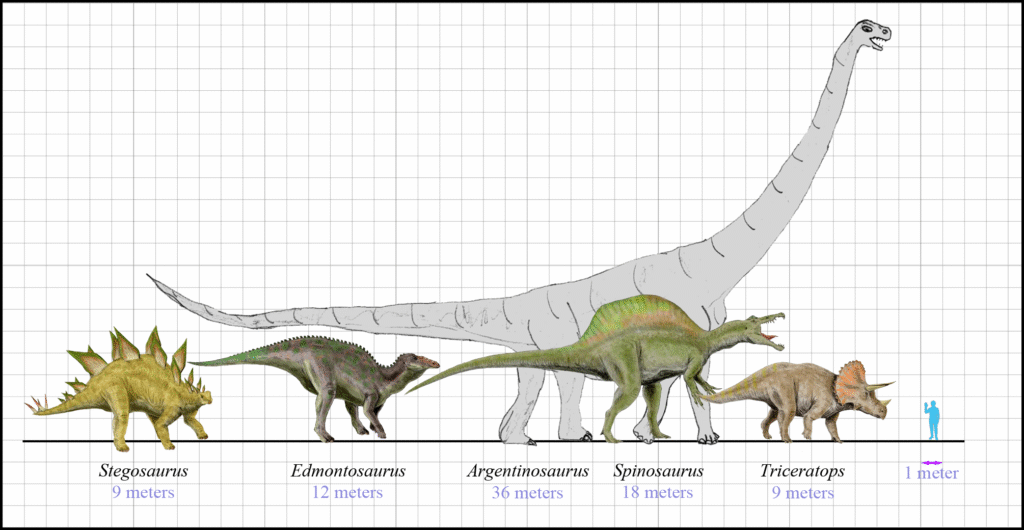
Created by Zachi Evenor. Source: https://www.flickr.com/photos/zachievenor/
License: CC BY-SA 4.0
Some stretched longer than a blue whale, and even the predators — think T. rex — were massive compared to today’s land animals. Why was the world of dinosaurs so supersized, while our largest land animal today, the African elephant, feels modest by comparison?
The answer lies in a mix of planetary conditions, evolutionary pressures, and a dash of cosmic influence. Let’s take a journey through the science — and the speculation.
1. Earth’s Climate: A Greenhouse Paradise
During the Mesozoic Era (about 250–66 million years ago), Earth was far warmer than it is today.
- No ice caps. Polar regions were forested, and winters were mild.
- High CO₂ levels. Carbon dioxide was 4–6 times higher than today, fueling explosive plant growth.
- Long growing seasons. Plants grew year-round, feeding enormous herbivores like Brachiosaurus.
In short, the world was a buffet. And with abundant food, nature could afford giants.
2. Oxygen Boosts and the Biology of Size
One fascinating clue lies in the air itself. Oxygen levels in parts of the Jurassic and Cretaceous were much higher than today’s 21%, possibly reaching 26–30%.
- Bigger lungs, bigger bodies. With more oxygen available, animals could support higher metabolic needs.
- Active lifestyles. Predators like Allosaurus could sustain bursts of activity, while giant herbivores had enough oxygen to keep their massive systems running.
Add to this the idea of gigantothermy — large animals naturally conserve heat, helping them regulate temperature even without being fully warm-blooded — and gigantism becomes an evolutionary advantage.
3. The Predator-Prey Arms Race
Size wasn’t just about climate — it was about survival.
- Herbivores grew larger as a defense against predators.
- Carnivores grew larger to keep up.
This evolutionary tug-of-war pushed both groups into a size spiral. Imagine herds of massive sauropods trampling through plains, with equally formidable predators stalking them — nature’s version of an arms race.
4. Planetary Conditions: Did Earth Make Giants Possible?
Some factors were planetary rather than biological:
- Continental Superhighways. The breakup of Pangaea created vast landmasses without modern barriers, giving giants room to roam.
- Shorter Days. Earth spun slightly faster — days were ~23 hours long. A small detail, but it may have influenced metabolism and growth cycles.
- Stable, Warm Oceans. With higher sea levels, coastlines expanded, creating rich ecosystems.
Interestingly, gravity hasn’t changed — Earth’s mass was the same then as now — so the idea of weaker gravity enabling dinosaurs’ size is a myth.
5. Cosmic Influences: A Subtle Background Role
Here’s where speculation enters. Could the universe itself have played a role?
- The Sun was slightly dimmer (~1% less luminous), but greenhouse gases kept Earth hot.
- Cosmic Rays fluctuate as Earth orbits the galaxy. Lower radiation levels might have supported warmer climates indirectly.
- Magnetic Shielding may have been stronger, protecting ecosystems from harmful radiation.
While these cosmic factors are intriguing, they were background players. The real stage was set by Earth itself.
6. Why Aren’t Today’s Animals as Big?
If conditions allowed giants before, why not now?
- Lower Oxygen & CO₂. Today’s atmosphere is leaner, limiting metabolic and plant productivity.
- Ice Caps & Seasons. Harsher climates make it harder to sustain giant year-round grazers.
- Asteroid Reset. The extinction 66 million years ago wiped the slate clean. Mammals evolved afterward, but their reproductive strategies and ecological niches never pushed them to dinosaurian extremes.
- Fragmented Habitats. Human activity and continental arrangements mean fewer wide-open spaces for giants.
The African elephant may be small compared to a sauropod, but in today’s world, it’s as large as land animals can reasonably get.
What If Dinosaurs Lived Today?
If we suddenly recreated Mesozoic conditions — higher oxygen, higher CO₂, vast forests, and a warmer climate — would giants return? Possibly. Evolution favors what works, and if the resources and space allowed, nature might once again produce land animals of astonishing size.
The Big Picture: Dinosaurs weren’t just accidents of evolution. They were products of a unique Earth — an atmosphere rich in oxygen and carbon dioxide, a climate built for growth, and ecosystems vast enough to sustain giants.
Their world was not just bigger in creatures, but in possibilities.
Leave a Reply