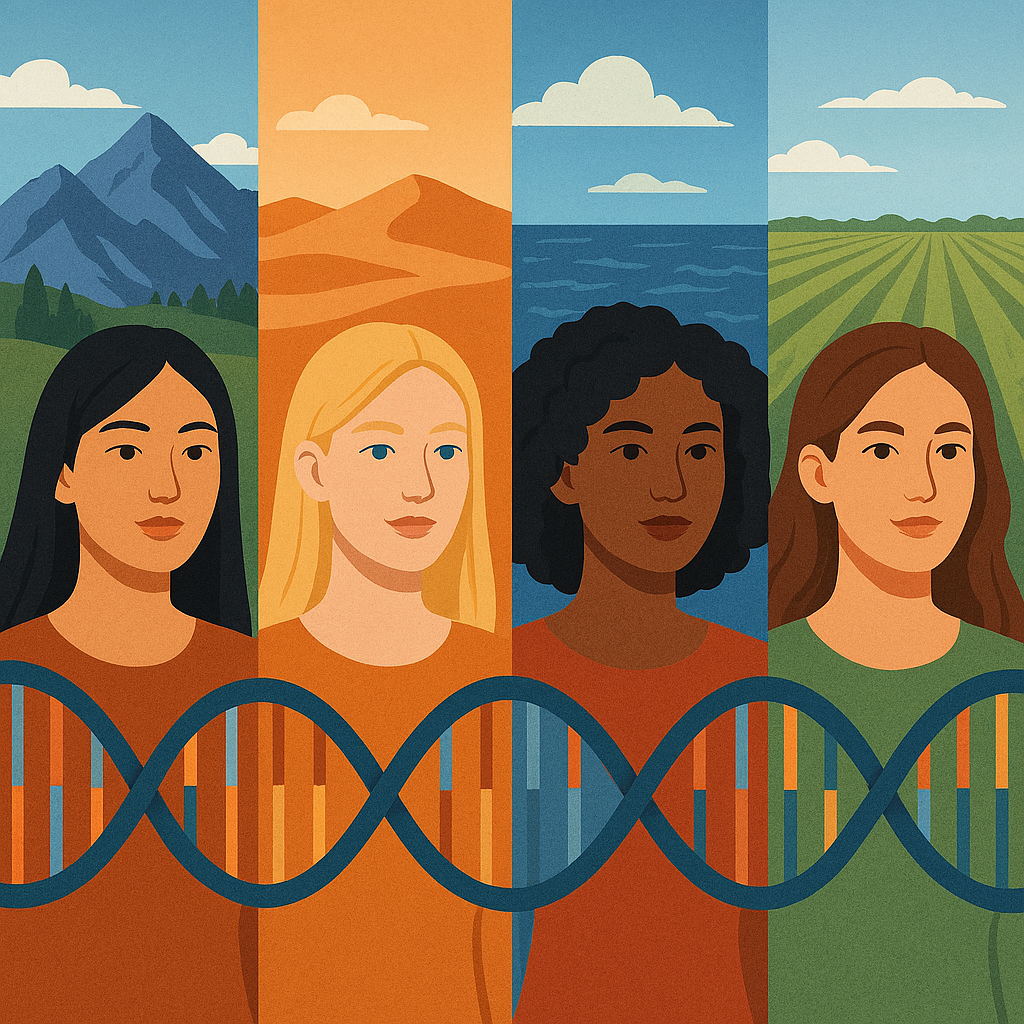
It is frequently stated that any two peoples’ genomes are ~99.9% identical to one another. In reality, any two peoples’ genomes are, on average, ~99.6% identical and ~0.4% different [Ref: National Human Genome Research Institute]. Even with the slightly increased difference from the popular notion, it is fair to say that genetically, we are identical. One of our nearest primate cousins, the chimpanzees, are subdivided into races, but humans are not [Ref: Templeton AR. Biological races in humans. Stud Hist Philos Biol Biomed Sci. 2013 Sep;44(3):262-71].
Adaptive traits, such as skin color, have frequently been used to define races in humans, but such adaptive traits reflect the underlying environmental factor to which they are adaptive and not overall genetic differentiation.
This raises an intriguing question.
If human beings are genetically so similar, why do human populations living across different regions have developed recognizable differences in physique, health patterns, behavioral tendencies, and social characteristics?
The answer may lie in one of the most fascinating ideas in modern biology:
Genes alone do not determine human outcomes.
People often imagine genes as rigid instructions. We all have come across phrases like having “good genes” or “bad genes,” but Genes Are Not Static Instructions.
Genes are dynamic, context-dependent resources rather than static, unchangeable instructions. Modern genomics shows that DNA functions as an open, reactive system. A single genetic sequence can produce vastly different outcomes depending on structural, chemical, and environmental context.
And this is where epigenetics enters the story.
Epigenetics is the study of heritable but reversible modifications in gene expression.
Epigenetics provides a powerful framework for understanding the regulation of gene expression through the interplay between genetic predispositions, inherited epigenetic marks, and lifelong environmental influences. [Ref: Jamshid Faraji, Gerlinde A.S. Metz, Environmental epigenetics: new horizons in redefining biological and health outcomes, Environment International, Volume 208, 2026,
110072.]
Importantly, epigenetics usually does not alter the DNA sequence itself. Instead, it modifies how genes are used.
A useful analogy is to think of DNA as the script of a play. Epigenetics influences which scenes are emphasized, which lines are muted, and how the performance unfolds under different conditions.
The same genome can therefore produce remarkably different outcomes depending on the environment surrounding it.
Beyond the Genetic Blueprint
The differences among human genomes are called genomic variants. A person’s set of genomic variants is part of what makes them unique. Most genomic variants have no influence on the functioning of a person’s genome, but a small subset of variants do have an impact [Ref: National Institutes of Health (US); Biological Sciences Curriculum Study. NIH Curriculum Supplement Series [Internet]. Bethesda (MD): National Institutes of Health (US); 2007. Understanding Human Genetic Variation]. For example, some genomic variants influence physical characteristics, like eye color and height; others influence health conditions or how a person responds to certain medications. Other factors (such as diet, environment, lifestyle, and social context) also contribute to a person’s uniqueness.
Human beings are not shaped in isolation. We are deeply ecological organisms. The landscapes we inhabit quietly influence diet, climate exposure, pathogen environments, labor intensity, stress levels, pollution exposure, social organization, and lifestyle patterns.
Over generations, these shared environmental conditions begin producing shared biological tendencies across populations living within the same geography.
This does not happen absolutely or deterministically. But geography exerts a continuous pressure that shapes developmental patterns over time.
Shared Geography Creates Shared Humans
Travel across northern India, and a fascinating pattern quietly emerges. Whether in Haryana, western Uttar Pradesh, or large parts of Rajasthan, people across different communities often appear remarkably similar in broad physical build, food habits, social temperament, and even behavioral rhythms. The similarities frequently transcend the social identities people use to define themselves. This agrarian belt of India across communities, generations have historically shared physically demanding agricultural labor, dairy-rich diets, hot climatic conditions, similar pathogen environments, common water systems, and comparable social structures.
These shared conditions influence human development in subtle but cumulative ways. Nutrition affects height and musculature. Labor shapes metabolism and physical adaptation. Climate influences behavioral rhythms and daily routines. Chronic environmental stressors shape hormonal systems and immune responses.
Over time, landscapes begin leaving signatures upon the humans who inhabit them.
The same broad principle appears globally.
Across the Mediterranean basin and the Middle East, populations separated by modern national borders often display overlapping facial structures, dietary cultures, and social behaviors shaped by centuries of living within similar climates and trade networks. In the United States, regional differences between the Deep South, the Northeast, the Midwest, and the Mountain West are not merely cultural stereotypes; they often reflect long histories of climate, labor patterns, food systems, urbanization, migration, and environmental pressures shaping populations over generations.
The Body Remembers Environment
One of the most remarkable discoveries in biology is that the body does not merely react to environments in the present. In some cases, environmental experiences can leave biological marks that persist across time.
A powerful example emerged from one of the darkest episodes of World War II: the Dutch Hunger Winter [Ref: Heijmans BT, Tobi EW, Stein AD, Putter H, Blauw GJ, Susser ES, Slagboom PE, Lumey LH. Persistent epigenetic differences associated with prenatal exposure to famine in humans. Proc Natl Acad Sci U S A. 2008 Nov 4;105(44):17046-9].
In the winter of 1944–45, a German blockade created a devastating famine in the Nazi-occupied Netherlands. Pregnant women exposed to severe starvation gave birth to children who later displayed increased risks of obesity, diabetes, cardiovascular disease, and metabolic disorders.
Decades later, researchers discovered altered epigenetic patterns associated with genes involved in growth and metabolism among individuals exposed to famine in the womb.
The DNA sequence itself had not changed.
What changed was how the body regulated the use of certain genes in response to extreme environmental stress.
This became one of the most influential demonstrations of how environments may biologically influence populations across time.
And famine is only one example.
Epigenetic influences are now being studied in relation to chronic stress, malnutrition, toxin exposure, pollution, trauma, socioeconomic hardship, sleep deprivation, and long-term inflammatory conditions.
What is striking is that many of these are not purely individual experiences.
They are often shared geographical realities.
The environment, therefore, becomes not just a backdrop to human life, but an active biological participant in shaping it.
Communities living within the same environments frequently encounter similar climates, nutritional systems, pollutants, labor demands, and stress structures.
Human Diversity Is Ecological
One of the most important insights emerging from modern biology is that human diversity cannot be understood purely through genetics alone.
Humans are adaptive organisms existing in constant dialogue with their surroundings.
The body continuously interprets environmental signals and adjusts accordingly; metabolism adapts to food availability, the immune system adapts to pathogen exposure, stress systems adapt to social pressures, and developmental pathways respond to nutrition and lifestyle.
This interaction between genes and environment helps explain why populations living in similar ecological conditions often display recognizable overlaps despite social divisions, linguistic differences, or historical identities.
It also explains why migration itself can reshape populations across generations. When environments change, lifestyles change. Diets change. Stress structures change. Exposure patterns change. And biology responds.
The human organism is not a fixed machine built solely from DNA.
It is a responsive system constantly negotiating with the world around it.
Landscapes Shape More Than Land
Perhaps one of the deepest misconceptions about human biology is the idea that genes alone define who we become.
Genes matter profoundly. But genes operate within environments, and environments are never passive.
Geography influences food systems. Food systems influence metabolism. Climate shapes labor patterns. Social structures influence stress. Pathogen environments shape immunity. Economic conditions influence development. Over generations, these forces interact continuously with human biology.
Landscapes do not merely shape civilizations.
They quietly shape the humans living within them.
Not absolutely. Not deterministically.
But continuously and powerfully across generations.
And perhaps that is one of the most fascinating truths about being human:
Identical genes do not create identical humans because human beings are not built by DNA alone.
We are shaped by the worlds we inhabit.
Leave a Reply